Advertisements
Advertisements
प्रश्न
Which of the following scientist invented the rule of electromagnetic induction?
विकल्प
Newton
Kepler
Mendeleev
Michael Faraday
Advertisements
उत्तर
Michael Faraday
संबंधित प्रश्न
The device used for producing electric current is called _________.
State three differences between direct current and alternating current.
A horizontal straight wire 10 m long extending from east to west is falling with a speed of 5.0 m s−1, at right angles to the horizontal component of the earth’s magnetic field, 0.30 × 10⁻⁴ Wb m−2.
- What is the instantaneous value of the emf induced in the wire?
- What is the direction of the emf?
- Which end of the wire is at the higher electrical potential?
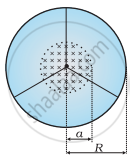
A line charge λ per unit length is lodged uniformly onto the rim of a wheel of mass M and radius R. The wheel has light non-conducting spokes and is free to rotate without friction about its axis (Figure). A uniform magnetic field extends over a circular region within the rim. It is given by,
B = − B0 k (r ≤ a; a < R)
= 0 (otherwise)
What is the angular velocity of the wheel after the field is suddenly switched off?
If ‘R’ is the radius of dees and ‘B’ be the magnetic field of induction in which positive charges (q) of mass (m) escape from the cyclotron, then its maximum speed (vmax) is _______.
A) `(qR)/(Bm)`
B)`(qm)/(Br)`
C) `(qBR)/m`
D) `m/(qBR)`
What is an electromagnet? Describe the construction and working of an electromagnet with the help of a labelled diagram.
Explain why, an electromagnet is called a temporary magnet.
State the factors on which the strength of an electromagnet depends. How does it depend on these factors?
Write some of the important uses of electromagnets.
What do you understand by the term "electromagnetic induction"? Explain with the help of a diagram.
Name one device which works on the phenomenon of electromagnetic induction.
How is the working of an electric bell affected, if alternating current be used instead of direct current?
In which of the following case does the electromagnetic induction occur?
The current is stopped in a wire held near a loop of wire .
In which of the following case does the electromagnetic induction occur?
A loop of wire is held near a magnet.
Electromagnetic induction means ______.
A conducting square loop having edges of length 2.0 cm is rotated through 180° about a diagonal in 0.20 s. A magnetic field B exists in the region which is perpendicular to the loop in its initial position. If the average induced emf during the rotation is 20 mV, find the magnitude of the magnetic field.
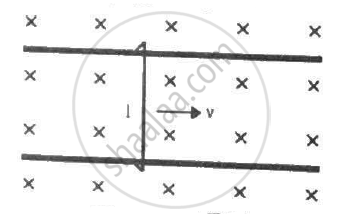
Figure shows a wire sliding on two parallel, conducting rails placed at a separation l. A magnetic field B exists in a direction perpendicular to the plane of the rails. What force is necessary to keep the wire moving at a constant velocity v?
Can a transformer work when it is connected to a D.C. source? Give a reason.
Name the following diagram and explain the concept behind it.
Draw a labelled diagram to show how an electromagnet is made.
What is an electromagnet? What do you know about the simplest form of an electromagnet?
You have been provided with a solenoid AB.
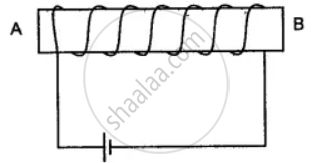
(i) What is the polarity at end A?
(ii) Give one advantage of an electromagnet over a permanent magnet.
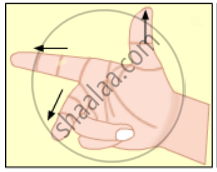
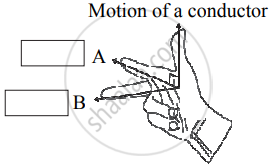
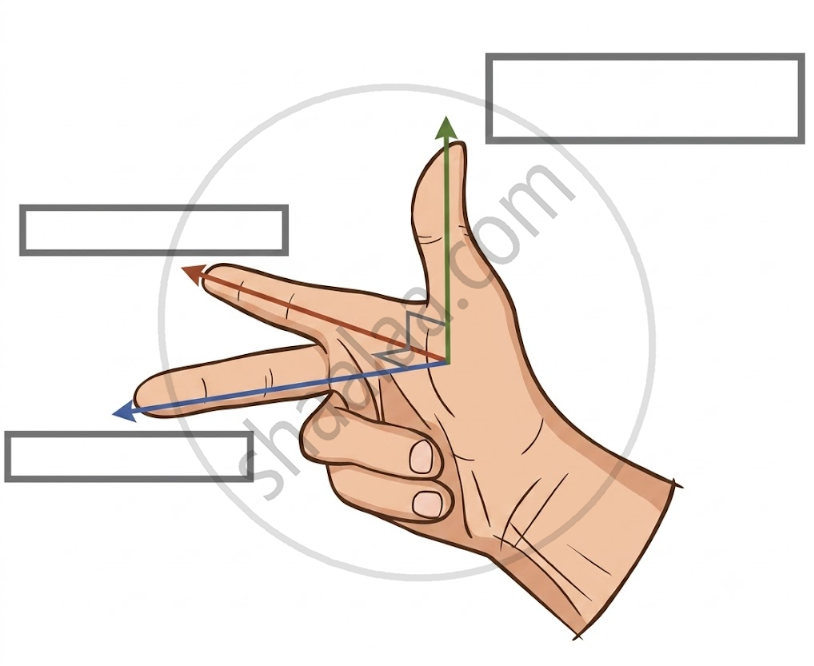
Observe the given figure of Fleming’s Right Hand Rule and write the labels of A and B correctly.
Write the two names in the following diagram.
Fleming’s right hand rule.
Show that Lenz’s law is in accordance with the law of conservation of energy.
A straight metal wire crosses a magnetic field of flux 4 mWb in a time 0.4 s. Find the magnitude of the emf induced in the wire.
A closely wound circular coil of radius 0.02 m is placed perpendicular to the magnetic field. When the magnetic field is changed from 8000 T to 2000 T in 6 s, an emf of 44 V is induced in it. Calculate the number of turns in the coil.
An induced current of 2.5 mA flows through a single conductor of resistance 100 Ω. Find out the rate at which the magnetic flux is cut by the conductor.
A coil of 200 turns carries a current of 4 A. If the magnetic flux through the coil is 6 x 10⁻⁵ Wb, find the magnetic energy stored in the medium surrounding the coil.
We can induce the current in a coil by ____________.
Which of the following instruments works by electromagnetic induction?
A coil of one turn is made of a wire of certain length and then from the same length, a coil of two turns is made. If the same current is passed in both the cases, then the ratio of the magnetic inductions at their centres will be:
Show that for a given positive ion species in a cyclotron, (i) the radius of their circular path inside a dee is directly proportional to their speed, and (ii) the maximum ion energy achievable is directly proportional to the square of the magnetic induction.
What do moving electric charges produce?
What is a solenoid?
Which device used for using electricity developed from Faraday’s and Henry’s experiments?
Which type of motor works on electromagnetic induction?
