Advertisements
Advertisements
प्रश्न
Show that Lenz’s law is in accordance with the law of conservation of energy.
Advertisements
उत्तर
- The truth of Lenz’s law can be established on the basis of the law of conservation of energy.
- According to Lenz’s law, when a magnet is moved either towards or away from a coil, the induced current produced opposes its motion.
- As a result, there will always be a resisting force on the moving magnet.
- Work has to be done by some external agency to move the magnet against this resisting force.
- Here the mechanical energy of the moving magnet is converted into electrical energy which in turn, gets converted into Joule heat in the coil i.e., energy is converted from one form to another.
APPEARS IN
संबंधित प्रश्न
The device used for producing electric current is called _________.
In which of the following case does the electromagnetic induction occur?
A magnet is moved through a loop of wire .
Can a transformer work when it is connected to a D.C. source? Give a reason.
Give an illustration of determining direction of induced current by using Lenz’s law.
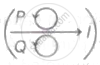
Metal rings P and Q are lying in the same plane, where current I is increasing steadily. The induced current in metal rings is shown correctly in figure.
Ansari Sir was demonstrating an experiment in his class with the setup as shown in the figure below.

A magnet is attached to a spring. The magnet can go in and out of the stationary coil. He lifted the Magnet and released it to make it oscillate through the coil.
Based on your understanding of the phenomenon, answer the following question.
What is the principle which Ansari Sir is trying to demonstrate?
Name some equipment that uses electromagnetism for functioning.
A conducting bar of length L is free to slide on two parallel conducting rails as shown in the figure

Two resistors R1 and R2 are connected across the ends of the rails. There is a uniform magnetic field `vec"B"` pointing into the page. An external agent pulls the bar to the left at a constant speed v. The correct statement about the directions of induced currents I1 and I2 flowing through R1 and R2 respectively is:
One solenoid is centered inside another. The outer one has a length of 50.0 cm and contains 6750 coils, while the coaxial inner solenoid is 3.0 cm long and π cm2 in area and contains 150 coils. The current in the outer solenoid is changing at 3000 A/s. The emf induced in the inner solenoid is ______ V.
(Round off to two decimal places.)
What do moving electric charges produce?
