Advertisements
Advertisements
प्रश्न
Explain the importance/uses of fuse wire.
Advertisements
उत्तर
- Fuse is an important application of heating effect of electric current used in electric circuits.
- It protects circuits and appliances by stopping the flow of any excess electric current.
- If a current larger than the specific value flows through the circuit, the temperature of fuse wire increases. This melts the fuse wire and breaks the circuit.
- In summer season, when consumption of electrical power is huge in the evening due to home lighting, fan, air conditioner, use of electricity in shops etc, an excessive current is drawn from the transformer. If the capacity of the transformer is insufficient, its fuse wire melts, and the supply gets shut down.
संबंधित प्रश्न
Why are the conductors of electric heating devices, such as bread-toasters and electric irons, made of an alloy rather than a pure metal?
Write Joule's law of heating.
What is nichrome? State its one use.
Give two reasons why nichrome alloy is used for making the heating elements of electrical appliances.
Why are the coils of electric irons and electric toasters made of an alloy rather than a pure metal?
An electric kettle rated at 220 V, 2.2 kW, works for 3 hours. Find the energy consumed and the current drawn.
A heating coil has a resistance of 200 Ω. At what rate will heat be produced in it when a current of 2.5 A flows through it?
How much heat will an instrument of 12 W produce in one minute if it is connected to the heat produced by it?
The heat produced by passing an electric current through a fixed resistor is proportional to the square of:
(a) magnitude of resistance of the resistor
(b) temperature of the resistor
(c) magnitude of current
(d) time for which current is passed
Two exactly similar heating resistances are connected (i) in series, and (ii) in parallel, in two different circuits, one by one. If the same current is passed through both the combinations, is more heat obtained per minute when they are connected in series or when they are connected in parallel? Give reason for your answer.
Three heaters each rated 250 W, 100 V are connected in parallel to a 100 V supply. Calculate:
- the total current taken from the supply
- the resistance of each heater and
- the energy supplied in kWh to the three heaters in 5 hours.
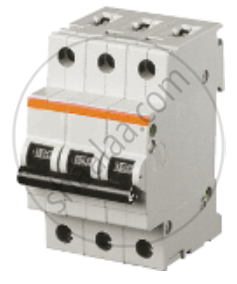
Identify the figure and give its use.
Heat energy is being produced in a resistance in a circuit at the rate of 100 W. The current of 3 A is flowing in the circuit. What must be the value of the resistance?
Why does tungsten metal used to make solenoid type coil in an electric bulb?
In an electric bulb, coil of _______ metal is used.
The electricity bill specifies the usage in _______.
These days when current in the circuit suddenly increases _______ switches are used.
A coil of an alloy _______ is used in electric heater cooker as a resistor.
Which of the following substance contracts on heating?
When does overloading occur?
What does overloading cause?
Which of the following is correct?
Mark the correct choice
- Assertion: Electric appliances with a metallic body have three wire connections.
- Reason: Three-pin connections reduce the heating of the connecting wires.
An electric iron consumes energy at the rate of 420 W when heating is at the maximum rate and 180 W when heating is at the minimum rate. The applied voltage is 220 V. What is the current in each case?
A current of 1 A is drawn by a filament of an electric bulb. Number of electrons passing through a cross-section of the filament in 16 seconds would be roughly:
Why is parallel arrangement used in domestic wiring?
Name two electric devices for each where
- heating effect of current is used and
- magnetic effect of current is used.
What is an electric fuse made up of?
What are the factors affecting heating effect of electric current?
______ wire is used in the filament of the bulbs.
Name the effect of the current responsible for the glow of the bulb in an electrical circuit.
The following is not a safety device.
An electrochemical cell converts ______ energy into ______ energy.
Explain why fuse wire is always connected in a series arrangement.
Find the odd one out.
1 kWh is equal to ______.
An electric kettle of 2 kW is used for 2h. Calculate the energy consumed in
- kilowatt hour and
- joules.
The graph of voltage vs current for four different materials is shown below.

Which of these four materials would be used for making filament of bulb?
