Advertisements
Advertisements
प्रश्न
Two exactly similar heating resistances are connected (i) in series, and (ii) in parallel, in two different circuits, one by one. If the same current is passed through both the combinations, is more heat obtained per minute when they are connected in series or when they are connected in parallel? Give reason for your answer.
Advertisements
उत्तर
Let the resistance be R.
In a series combination:
Net resistance = R + R = 2R
In a parallel combination
`1/"net resistance"=1/R+1/R=2/R`
Net resistance = `R/2`
It is clear that the net resistance is more in the series combination. Therefore, more heat will be obtained in a series connection, as the heat produced is directly proportional to the resistance in the circuit.
APPEARS IN
संबंधित प्रश्न
Compute the heat generated while transferring 96000 coulomb of charge in one hour through a potential difference of 50 V.
How does the resistance of a wire vary with its area of cross-section?
An electric room heater draws a current of 2.4 A from the 120 V supply line. What current will this room heater draw when connected to 240 V supply line?
Statement 1 : Electric current ( flow of electrons ) creates heat in the resistor.
Statement 2 : Heat in the resistor is created according to the rule of energy conservation.
Explain Statement 1 with the help of Statement 2.
Name any six domestic appliances based on the heating effect of electric current.
Rewrite the following statement by selecting the correct option:
1 A = ____________ mA.
In an electric bulb, coil of _______ metal is used.
Write scientific reason.
A coil made up of alloy Nichrome is used in the electric heater cooker as a resistor.
Explain the importance/uses of fuse wire.
True or False – If False give the correct answer
The fuse wire does not melts whenever there is overload in the wiring.
Explain the heating effect of electric current.
The heating element of an electric iron is made up of:
(a) Observe the diagram given below and state whether the bulb will glow or not when we switch on K.
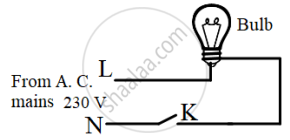
(b) Is it safe to handle the bulb when the switch is OFF?
(c) Give a reason for your answer in (b).
When a switch is in OFF position,
- circuit starting from the positive terminal of the cell stops at the switch.
- circuit is open.
- no current flows through it.
- current flows after some time.
Choose the combination of correct answer from the following.
What is an electric fuse made up of?
What are the factors affecting heating effect of electric current?
A student boils water in an electric kettle for 20 minutes. Using the same mains supply he wants to reduce the boiling time of water. To do so should he increase or decrease the length of the heating element? Justify your answer.
An electrochemical cell converts ______ energy into ______ energy.
Explain why fuse wire is always connected in a series arrangement.
