Advertisements
Advertisements
Question
Two exactly similar heating resistances are connected (i) in series, and (ii) in parallel, in two different circuits, one by one. If the same current is passed through both the combinations, is more heat obtained per minute when they are connected in series or when they are connected in parallel? Give reason for your answer.
Advertisements
Solution
Let the resistance be R.
In a series combination:
Net resistance = R + R = 2R
In a parallel combination
`1/"net resistance"=1/R+1/R=2/R`
Net resistance = `R/2`
It is clear that the net resistance is more in the series combination. Therefore, more heat will be obtained in a series connection, as the heat produced is directly proportional to the resistance in the circuit.
APPEARS IN
RELATED QUESTIONS
State four most common electrical appliances based on heating effect of electric current. Why do we use finely heated platinum wire in surgery?
A heating coil has a resistance of 200 Ω. At what rate will heat be produced in it when a current of 2.5 A flows through it?
The current passing through an electric kettle has been doubled. The heat produced will become:
(a) half
(b) double
(c) four time
(d) one-fourth
An electric fuse works on the:
(a) chemical effect of current
(b) magnetic effect of current
(c) lighting effect of current
(d) heating effect of current
The electrical resistivities of four materials P, Q, R and S are given below:
| P | `6.84xx10^8`Ωm |
| Q | `1.70xx10^8`Ωm |
| R | ` 1.0xx10^15`Ωm |
| s | `11.0xx10^-7`Ωm |
Which material will you use for making: (a) heating element of electric iron (b) connecting wires of electric iron (c) covering of connecting wires? Give reason for your choice in each case.
Identify the figure and give its use.
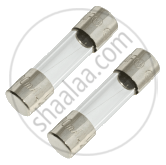
What does overloading cause?
Explain the application of heating effect of electric current in an electric bulb with a diagram.
True or False – If False give the correct answer
The fuse wire does not melts whenever there is overload in the wiring.
An electric iron consumes energy at the rate of 420 W when heating is at the maximum rate and 180 W when heating is at the minimum rate. The applied voltage is 220 V. What is the current in each case?
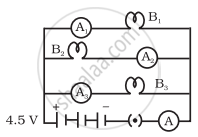
B1, B2 and B3 are three identical bulbs connected as shown in Figure. When all the three bulbs glow, a current of 3A is recorded by the ammeter A.
- What happens to the glow of the other two bulbs when the bulb B1 gets fused?
- What happens to the reading of A1, A2, A3 and A when the bulb B2 gets fused?
- How much power is dissipated in the circuit when all the three bulbs glow together?
(a) Observe the diagram given below and state whether the bulb will glow or not when we switch on K.
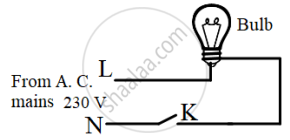
(b) Is it safe to handle the bulb when the switch is OFF?
(c) Give a reason for your answer in (b).
Name two electric devices for each where
- heating effect of current is used and
- magnetic effect of current is used.
What is an electric fuse made up of?
______ wire is used in the filament of the bulbs.
Copper wire offers very little ______ and does not get heated up quickly.
What is a trip switch?
State the law that explains the heating effect of current with respect to the measurable properties in an electrical circuit.
Anannya responded to the question: Why do electrical appliances with metallic bodies are connected to the mains through a three-pin plug, whereas an electric bulb can be connected with a two-pin plug?
She wrote: Three-pin connections reduce heating of connecting wires.
- Is her answer correct or incorrect? Justify.
- What is the function of a fuse in a domestic circuit?
An electric iron of resistance 20 Ω draws a current of 5 A. The heat developed in the iron in 30 seconds is ______.
