Advertisements
Advertisements
प्रश्न
Heat energy is being produced in a resistance in a circuit at the rate of 100 W. The current of 3 A is flowing in the circuit. What must be the value of the resistance?
Advertisements
उत्तर
Given: Power, P = 100 W
Current, I = 3 A
Resistance, R = ?
We know, P = I2R
⇒ R = `P/I^2`
= `100/3^2`
= `100/9`
= 11.11 Ω
∴ The value of the resistance is 11.11 Ω.
APPEARS IN
संबंधित प्रश्न
Compute the heat generated while transferring 96000 coulomb of charge in one hour through a potential difference of 50 V.
An electric heater of resistance 8 Ω draws 15 A from the service mains 2 hours. Calculate the rate at which heat is developed in the heater.
How does the resistance of a wire vary with its area of cross-section?
An electric heater is connected to the 230 V mains supply. A current of 8 A flows through the heater.
(b) How much energy is transferred to the heater each second?
A resistance of 25 Ω is connected to a 12 V battery. Calculate the heat energy in joules generated per minute.
Derive the expression for the heat produced due to a current 'I' flowing for a time interval 't' through a resistor 'R' having a potential difference 'V' across its ends. With which name is this relation known?
The heat produced by passing an electric current through a fixed resistor is proportional to the square of:
(a) magnitude of resistance of the resistor
(b) temperature of the resistor
(c) magnitude of current
(d) time for which current is passed
The current passing through an electric kettle has been doubled. The heat produced will become:
(a) half
(b) double
(c) four time
(d) one-fourth
The elements of electrical heating devices are usually made of:
(a) tungsten
(b) bronze
(c) nichrome
(d) argon
Which of the following characteristic is not suitable for a fuse wire?
(a) thin and short
(b) thick and short
(c) low melting point
(d) higher resistance than rest of wiring
Give Scientific reasons.
In the electric equipment producing heat e.g. iron, electric heater, boiler, toaster etc, an alloy such as Nichrome is used, not pure metals.
Identify the figure and give its use.
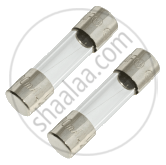
An electric iron of 1100 W is operated for 2 hrs daily. What will be the electrical consumption expenses for that in the month of April? (The electric company charges Rs 5 per unit of energy).
Give scientific reason :
In the electric equipment producing heat e.g. iron, electric heater, boiler, toaster, etc., an alloy such as Nichrome is used, not pure metals.
Rewrite the following statement by selecting the correct option:
1 A = ____________ mA.
Answer the following question:
what is the heating effect of the electric current? state any four applications of it?
In an electric bulb, coil of _______ metal is used.
The electricity bill specifies the usage in _______.
A coil of an alloy _______ is used in electric heater cooker as a resistor.
What is used to turn off the sudden increase in current in the electrical circuit of the house nowadays?
Right or wrong sentence.
Live wire and neutral wires have a 220 V potential difference.
Explain the importance/uses of fuse wire.
Define fuse.
Heating effect of current is called ______
An electric iron consumes energy at the rate of 420 W when heating is at the maximum rate and 180 W when heating is at the minimum rate. The applied voltage is 220 V. What is the current in each case?
The heating element of an electric iron is made up of:
Which of the following gases are filled in electric bulbs?
An electric cell produces electricity from the ______ ______ in it.
Unscramble the following words:
SFEU
What is an electric fuse made up of?
What are the factors affecting heating effect of electric current?
Name the effect of the current responsible for the glow of the bulb in an electrical circuit.
In the electric equipment producing heat like iron, electric heater, boiler, toaster etc., an alloy such as nichrome is used, not pure metals.
An electric kettle consumes 1 kW of electric power when operated at 220 V. A fuse wire of what rating must be used for it?
The graph of voltage vs current for four different materials is shown below.

Which of these four materials would be used for making filament of bulb?
An electric iron is rated 220 V, 2 kW. If the iron is used for 3h daily find the cost of running it for one week if it costs ₹ 4.25 per kWh.
