Advertisements
Advertisements
प्रश्न
Two students decided to investigate the effect of water and air on iron object under identical experimental conditions. They measured the mass of each object before placing it partially immersed in 10 ml of water. After a few days, the object were removed, dried and their masses were measured. The table shows their results.
| Student | Object | Mass of Object before Rusting in g |
Mass of the coated object in g |
| A | Nail | 3.0 | 3.15 |
| B | Thin plate | 6.0 | 6.33 |
What might be the reason for the varied observations of the two students?
Advertisements
उत्तर
Rusting occurs in both A and B so there is an increase in mass. As the surface area of B is more, extent of rusting is more.
APPEARS IN
संबंधित प्रश्न
Explain why, the current that makes the heater element very hot, only slightly warms the connecting wires leading to the heater.
The heat produced by passing an electric current through a fixed resistor is proportional to the square of:
(a) magnitude of resistance of the resistor
(b) temperature of the resistor
(c) magnitude of current
(d) time for which current is passed
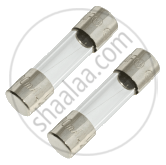
Identify the figure and give its use.
The ‘live’ and the ‘neutral’ wires have potential difference of _______.
How does use of a fuse wire protect electrical appliances?
An electric cell produces electricity from the ______ ______ in it.
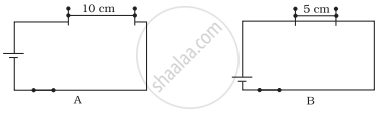
Paheli took a wire of length 10 cm. Boojho took a wire of 5 cm of the same material and thickness. Both of them connected the wires as shown in the circuit given in the following figure. The current flowing in both the circuits is the same.
- Will the heat produced in both cases be equal? Explain.
- Will the heat produced be the same if the wires taken by them are of equal lengths but of different thickness? Explain.
Name a few appliances which work on the basis of the heating effect of current.
An electrochemical cell converts ______ energy into ______ energy.
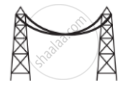
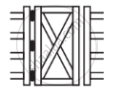
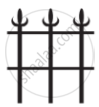
In which of the following applications of Iron, rusting will occur most? Support your answer with valid reason.
| A | B | C | D |
 |
 |
 |
 |
