Advertisements
Advertisements
प्रश्न
An electric cell produces electricity from the ______ ______ in it.
Advertisements
उत्तर
An electric cell produces electricity from the chemicals stored in it.
Explanation:
An electric cell converts chemical energy stored in its chemicals (usually through a chemical reaction between the electrolyte and the electrodes) into electrical energy. This energy is then used to power electrical devices connected to the cell.
APPEARS IN
संबंधित प्रश्न
Why does the cord of an electric heater not glow while the heating element does?
Compute the heat generated while transferring 96000 coulomb of charge in one hour through a potential difference of 50 V.
An electric heater is connected to the 230 V mains supply. A current of 8 A flows through the heater.
(b) How much energy is transferred to the heater each second?
How much heat will an instrument of 12 W produce in one minute if it is connected to the heat produced by it?
Give a scientific reason:
For electric power transmission, copper or aluminium wire is used.
An electric iron of 1100 W is operated for 2 hrs daily. What will be the electrical consumption expenses for that in the month of April? (The electric company charges Rs 5 per unit of energy).
Write two devices based on the heating effect of electric current.
Name any two appliances which works on the phenomenon of heating effect of electric current.
(a) Observe the diagram given below and state whether the bulb will glow or not when we switch on K.
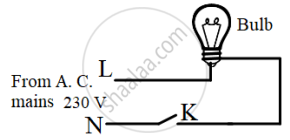
(b) Is it safe to handle the bulb when the switch is OFF?
(c) Give a reason for your answer in (b).
Two students decided to investigate the effect of water and air on iron object under identical experimental conditions. They measured the mass of each object before placing it partially immersed in 10 ml of water. After a few days, the object were removed, dried and their masses were measured. The table shows their results.
| Student | Object | Mass of Object before Rusting in g |
Mass of the coated object in g |
| A | Nail | 3.0 | 3.15 |
| B | Thin plate | 6.0 | 6.33 |
What might be the reason for the varied observations of the two students?
