Advertisements
Advertisements
प्रश्न
An electric heater is connected to the 230 V mains supply. A current of 8 A flows through the heater.
(b) How much energy is transferred to the heater each second?
Advertisements
उत्तर
Here, potential, V = 230 V
Current, I = 8 A
Energy transferred = Work done, W
Using the relation, V = W/Q:
W = V x Q
= 230 x 8 = 1840 J
Thus, 1840 joules of energy is transferred to the heater each second.
संबंधित प्रश्न
State four most common electrical appliances based on heating effect of electric current. Why do we use finely heated platinum wire in surgery?
An electric room heater draws a current of 2.4 A from the 120 V supply line. What current will this room heater draw when connected to 240 V supply line?
Why are the coils of electric irons and electric toasters made of an alloy rather than a pure metal?
An electric kettle rated at 220 V, 2.2 kW, works for 3 hours. Find the energy consumed and the current drawn.
Why does the connecting cord of an electric heater not glow hot while the heating element does?
The heat produced by passing an electric current through a fixed resistor is proportional to the square of:
(a) magnitude of resistance of the resistor
(b) temperature of the resistor
(c) magnitude of current
(d) time for which current is passed
Which electric heating device in your home do you think have resistors which control the flow of electricity?
Heat energy is being produced in a resistance in a circuit at the rate of 100 W. The current of 3 A is flowing in the circuit. What must be the value of the resistance?
Why does tungsten metal used to make solenoid type coil in an electric bulb?
Define fuse.
An electric iron draws a current of 4 A when connected to 220 V mains. Its resistance must be:
What is Joule’s heating effect? How can it be demonstrated experimentally? List its four applications in daily life.
Explain the working of an electric fuse.
Fuse is a strip of alloy wire which is made up of lead and tin with a very low ______.
What is a trip switch?
The following is not a safety device.
An electrochemical cell converts ______ energy into ______ energy.
A fuse is used in an electric circuit to stop high currents flowing through the circuit.
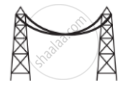
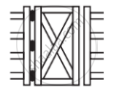
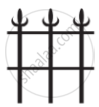
In which of the following applications of Iron, rusting will occur most? Support your answer with valid reason.
| A | B | C | D |
 |
 |
 |
 |
State the law that explains the heating effect of current with respect to the measurable properties in an electrical circuit.
