Advertisements
Advertisements
प्रश्न
An electric heater is connected to the 230 V mains supply. A current of 8 A flows through the heater.
(b) How much energy is transferred to the heater each second?
Advertisements
उत्तर
Here, potential, V = 230 V
Current, I = 8 A
Energy transferred = Work done, W
Using the relation, V = W/Q:
W = V x Q
= 230 x 8 = 1840 J
Thus, 1840 joules of energy is transferred to the heater each second.
संबंधित प्रश्न
Why is the tungsten used almost exclusively for filament of electric lamps?
Name the material which is used for making the filaments of an electric bulb.
The heat produced by passing an electric current through a fixed resistor is proportional to the square of:
(a) magnitude of resistance of the resistor
(b) temperature of the resistor
(c) magnitude of current
(d) time for which current is passed
Which of the following characteristic is not suitable for a fuse wire?
(a) thin and short
(b) thick and short
(c) low melting point
(d) higher resistance than rest of wiring
How does the wire in the filament of a light bulb behave differently to the other wires in the circuit when the current flows?
What property of the filament wire accounts for this difference?
Solve the following example.
Two tungsten bulbs of wattage 100 W and 60 W power work on 220 V potential difference. If they are connected in parallel, how much current will flow in the main conductor?
Write scientific reason.
A coil made up of alloy Nichrome is used in the electric heater cooker as a resistor.
True or False – If False give the correct answer
The fuse wire does not melts whenever there is overload in the wiring.
A fuse wire repeatedly gets burnt when used with a good heater. It is advised to use a fuse wire of:
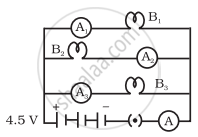
B1, B2 and B3 are three identical bulbs connected as shown in Figure. When all the three bulbs glow, a current of 3A is recorded by the ammeter A.
- What happens to the glow of the other two bulbs when the bulb B1 gets fused?
- What happens to the reading of A1, A2, A3 and A when the bulb B2 gets fused?
- How much power is dissipated in the circuit when all the three bulbs glow together?
When a switch is in OFF position,
- circuit starting from the positive terminal of the cell stops at the switch.
- circuit is open.
- no current flows through it.
- current flows after some time.
Choose the combination of correct answer from the following.
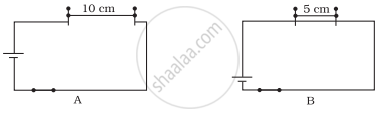
Paheli took a wire of length 10 cm. Boojho took a wire of 5 cm of the same material and thickness. Both of them connected the wires as shown in the circuit given in the following figure. The current flowing in both the circuits is the same.
- Will the heat produced in both cases be equal? Explain.
- Will the heat produced be the same if the wires taken by them are of equal lengths but of different thickness? Explain.
What are the uses of electromagnets?
Match the following
| 1. | Bulb | a. | Conductor |
| 2. | Electroplating | b. |
Insulator |
| 3. | Pure water | c. | Heating effect of current |
| 4. | Salt solution | d. | Chemical effect of current |
Name the effect of the current responsible for the glow of the bulb in an electrical circuit.
An electrochemical cell converts ______ energy into ______ energy.
Define the following:
Electrolyte
Tara, after completing her exams, went to her grandmother's house along with her younger brother Rahul. One day, Rahul came home after playing and switched on the fan and air conditioner. At the same time, his grandmother was preparing a milkshake for him using a mixer. Suddenly, they heard a big sound and the electricity of the house got shut down. Tara is called an electrician. He said the main reason for supply to shut down was overloading.
- What is overloading?
- Is overloading and short the same? When does short-circuiting take place?
- How can the effects of overloading be avoided?
Find the odd one out.
An electric iron is rated 220 V, 2 kW. If the iron is used for 3h daily find the cost of running it for one week if it costs ₹ 4.25 per kWh.
