Advertisements
Advertisements
प्रश्न
Why does tungsten metal used to make solenoid type coil in an electric bulb?
Advertisements
उत्तर
Tungsten metal is used to make solenoid type coil in an electric bulb because:
- Tungsten metal has high resistance and high melting point (nearly 3422°C)
- Because of current it gets heated at high temperature and emits light.
APPEARS IN
संबंधित प्रश्न
State four most common electrical appliances based on heating effect of electric current. Why do we use finely heated platinum wire in surgery?
An electric heater of resistance 8 Ω draws 15 A from the service mains 2 hours. Calculate the rate at which heat is developed in the heater.
Write Joule's law of heating.
An electric iron of resistance 20 ohms draws a current of 5 amperes. Calculate the heat produced in 30 seconds.
Explain why, the current that makes the heater element very hot, only slightly warms the connecting wires leading to the heater.
A resistance of 25 Ω is connected to a 12 V battery. Calculate the heat energy in joules generated per minute.
If the current flowing through a fixed resistor is halved, the heat produced in it will become:
The electrical resistivities of four materials P, Q, R and S are given below:
| P | `6.84xx10^8`Ωm |
| Q | `1.70xx10^8`Ωm |
| R | ` 1.0xx10^15`Ωm |
| s | `11.0xx10^-7`Ωm |
Which material will you use for making: (a) heating element of electric iron (b) connecting wires of electric iron (c) covering of connecting wires? Give reason for your choice in each case.
Which electric heating device in your home do you think have resistors which control the flow of electricity?
Give Scientific reason.
In practice, the unit kWh is used for the measurement of electrical energy, rather than joule.
Identify the figure and give its use.
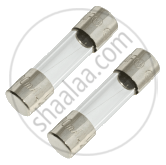
Identify the figure and give its use.
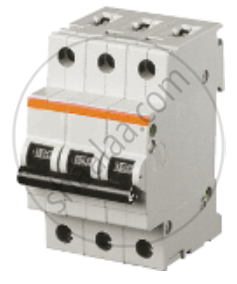
Statement 1 : Electric current ( flow of electrons ) creates heat in the resistor.
Statement 2 : Heat in the resistor is created according to the rule of energy conservation.
Explain Statement 1 with the help of Statement 2.
Rewrite the following statement by selecting the correct option:
1 A = ____________ mA.
In an electric bulb, coil of _______ metal is used.
Find the odd one out and give its explanation.
What is the heating effect of electric current?
Which metal is used to make the filament of an electric bulb?
What is a short circuit?
What is overloading?
What is used to turn off the sudden increase in current in the electrical circuit of the house nowadays?
Write two devices based on the heating effect of electric current.
Write scientific reason.
A coil made up of alloy Nichrome is used in the electric heater cooker as a resistor.
Name some devices that run using heat effect of electric current
Explain the heating effect of electric current.
Heating effect of current is called ______
Which of the following gases are filled in electric bulbs?
How does use of a fuse wire protect electrical appliances?
Unscramble the following words:
SFEU
Your teacher has shown you the following activity.
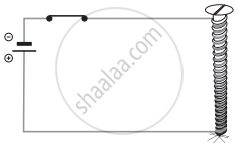
Activity: Teacher has wound a long insulated piece of wire around an iron nail in the form of a coil. Free ends of the wire are connected to a cell through a switch as shown in the following figure. The current is switched on and some pins are placed near the ends of the nail.
Write down any three questions that come to your mind about this activity.
An MCB can be used instead of a fuse in an electrical circuit.
______ wire is used in the filament of the bulbs.
An electrochemical cell converts ______ energy into ______ energy.
If 220 V potential difference is applied across an electric bulb, a current of 0.45 A flows in the bulb. What must be the power of the bulb?
An electric kettle of 2 kW is used for 2h. Calculate the energy consumed in
- kilowatt hour and
- joules.
An electric iron of resistance 20 Ω draws a current of 5 A. The heat developed in the iron in 30 seconds is ______.
