Advertisements
Advertisements
प्रश्न
True or False – If False give the correct answer
The fuse wire does not melts whenever there is overload in the wiring.
विकल्प
True
False
Advertisements
उत्तर
False.
The fuse wire melts whenever there is overload in the wiring.
APPEARS IN
संबंधित प्रश्न
An electric iron of resistance 20 Ω takes a current of 5 A. Calculate the heat developed in 30 s.
What is meant by the heating effect of current?
If the current flowing through a fixed resistor is halved, the heat produced in it will become:
Name any six domestic appliances based on the heating effect of electric current.
How does use of a fuse wire protect electrical appliances?
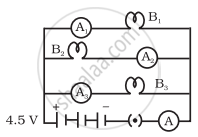
B1, B2 and B3 are three identical bulbs connected as shown in Figure. When all the three bulbs glow, a current of 3A is recorded by the ammeter A.
- What happens to the glow of the other two bulbs when the bulb B1 gets fused?
- What happens to the reading of A1, A2, A3 and A when the bulb B2 gets fused?
- How much power is dissipated in the circuit when all the three bulbs glow together?
Assertion: A current-carrying wire should be charged.
Reason: The current in a wire is due to the flow of free electrons in a definite direction.
A trip switch is a ______ safety device.
A fuse is used in an electric circuit to stop high currents flowing through the circuit.
What is the heating effect of electric current?
