Advertisements
Advertisements
प्रश्न
Give Scientific reason.
In practice, the unit kWh is used for the measurement of electrical energy, rather than joule.
Advertisements
उत्तर
- Electrical energy = Electrical power × time.
- For practical applications, devices consuming high electrical power are used over a period of time.
- This leads to heavy expenditure of electrical energy. To measure such value of energy unit joule is significantly small.
Hence, unit kWh is used in practice. Unit 1 kWh represents power of 1 kW used for 1 hour and equals 3.6 × 10⁶ J.
APPEARS IN
संबंधित प्रश्न
Why is the tungsten used almost exclusively for filament of electric lamps?
How does the resistance of a wire vary with its area of cross-section?
When current is switched ‘on’ in a room heater, it ______.
An electric room heater draws a current of 2.4 A from the 120 V supply line. What current will this room heater draw when connected to 240 V supply line?
What is nichrome? State its one use.
What is meant by the heating effect of current?
The heat produced by passing an electric current through a fixed resistor is proportional to the square of:
(a) magnitude of resistance of the resistor
(b) temperature of the resistor
(c) magnitude of current
(d) time for which current is passed
The heat produced in a wire of resistance 'x' when a current 'y' flows through it in time 'z' is given by:
(a) x2 × y × z
(b) x × z × y2
(c) y × z2 × x
(d) y × z × x
Which of the following characteristic is not suitable for a fuse wire?
(a) thin and short
(b) thick and short
(c) low melting point
(d) higher resistance than rest of wiring
If the current flowing through a fixed resistor is halved, the heat produced in it will become:
How does the wire in the filament of a light bulb behave differently to the other wires in the circuit when the current flows?
What property of the filament wire accounts for this difference?
An electric iron is connected to the mains power supply of 220 V. When the electric iron is adjusted at ‘minimum heating' it consumes a power of 360 W but at 'maximum heating’ it takes a power of 840 W. Calculate the current and resistance in each case.
Give a scientific reason.
Tungsten metal is used to make a solenoid type coil in an electric bulb.
Give Scientific reasons.
In the electric equipment producing heat e.g. iron, electric heater, boiler, toaster etc, an alloy such as Nichrome is used, not pure metals.
Identify the figure and give its use.
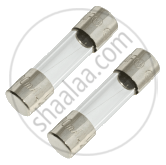
Statement 1 : Electric current ( flow of electrons ) creates heat in the resistor.
Statement 2 : Heat in the resistor is created according to the rule of energy conservation.
Explain Statement 1 with the help of Statement 2.
Compute the heat generated while transferring 96000 coulombs of charge in two hours through a potential difference of 40 V.
The ‘live’ and the ‘neutral’ wires have potential difference of _______.
What is overloading?
Name any two appliances which works on the phenomenon of heating effect of electric current.
When does overloading occur?
Explain the heating effect of electric current.
Which of the following is correct?
An electric bulb is connected to a 220 V generator. The current is 0.50 A. What is the power of the bulb?
Three incandescent bulbs of 100 W each are connected in series in an electric circuit. In another circuit another set of three bulbs of the same wattage are connected in parallel to the same source.
- Will the bulb in the two circuits glow with the same brightness? Justify your answer.
- Now let one bulb in both the circuits get fused. Will the rest of the bulbs continue to glow in each circuit? Give reason.
When a switch is in OFF position,
- circuit starting from the positive terminal of the cell stops at the switch.
- circuit is open.
- no current flows through it.
- current flows after some time.
Choose the combination of correct answer from the following.
Unscramble the following words:
SFEU
An MCB can be used instead of a fuse in an electrical circuit.
What are the factors affecting heating effect of electric current?
Explain the working of an electric fuse.
It would cost a man Rs. 3.50 to buy 1.0 kW h of electrical energy from the Main Electricity Board. His generator has a maximum power of 2.0 kW. The generator produces energy at this maximum power for 3 hours. Calculate how much it would cost to buy the same amount of energy from the Main Electricity Board.
Fuse is a strip of alloy wire which is made up of lead and tin with a very low ______.
Match the following
| 1. | Bulb | a. | Conductor |
| 2. | Electroplating | b. |
Insulator |
| 3. | Pure water | c. | Heating effect of current |
| 4. | Salt solution | d. | Chemical effect of current |
A fuse is used in an electric circuit to stop high currents flowing through the circuit.
The electric fuse works on the Joule heating principle.
Find the odd one out.
State the law that explains the heating effect of current with respect to the measurable properties in an electrical circuit.
