Advertisements
Advertisements
प्रश्न
Which metal is used to make the filament of an electric bulb?
Advertisements
उत्तर
Tungsten metal is used to make the filament of an electric bulb.
APPEARS IN
संबंधित प्रश्न
How does the resistance of a wire vary with its area of cross-section?
The safety device based on the heating effect of electric current is called a ______.
Why does the connecting cord of an electric heater not glow hot while the heating element does?
Explain why, tungsten is used for making the filaments of electric bulbs.
A resistance of 25 Ω is connected to a 12 V battery. Calculate the heat energy in joules generated per minute.
Derive the expression for the heat produced due to a current 'I' flowing for a time interval 't' through a resistor 'R' having a potential difference 'V' across its ends. With which name is this relation known?
The electrical resistivities of four materials P, Q, R and S are given below:
| P | `6.84xx10^8`Ωm |
| Q | `1.70xx10^8`Ωm |
| R | ` 1.0xx10^15`Ωm |
| s | `11.0xx10^-7`Ωm |
Which material will you use for making: (a) heating element of electric iron (b) connecting wires of electric iron (c) covering of connecting wires? Give reason for your choice in each case.
Two exactly similar heating resistances are connected (i) in series, and (ii) in parallel, in two different circuits, one by one. If the same current is passed through both the combinations, is more heat obtained per minute when they are connected in series or when they are connected in parallel? Give reason for your answer.
An electric iron is connected to the mains power supply of 220 V. When the electric iron is adjusted at ‘minimum heating' it consumes a power of 360 W but at 'maximum heating’ it takes a power of 840 W. Calculate the current and resistance in each case.
Statement 1 : Electric current ( flow of electrons ) creates heat in the resistor.
Statement 2 : Heat in the resistor is created according to the rule of energy conservation.
Explain Statement 1 with the help of Statement 2.
Write the mathematical expression for Joule’s law of heating.
These days when current in the circuit suddenly increases _______ switches are used.
What is overloading?
Right or wrong sentence.
Live wire and neutral wires have a 220 V potential difference.
Write scientific reason.
A coil made up of alloy Nichrome is used in the electric heater cooker as a resistor.
Name any two appliances which works on the phenomenon of heating effect of electric current.
When does overloading occur?
Name some devices that run using heat effect of electric current
Name any two appliances which work under the principle of heating effect of current.
Assertion: Bending of wire decreases the resistance of the electric wire.
Reason: The resistance of a conductor depends on length, thickness, nature of material and temperature of the conductor.
How does use of a fuse wire protect electrical appliances?
Three incandescent bulbs of 100 W each are connected in series in an electric circuit. In another circuit another set of three bulbs of the same wattage are connected in parallel to the same source.
- Will the bulb in the two circuits glow with the same brightness? Justify your answer.
- Now let one bulb in both the circuits get fused. Will the rest of the bulbs continue to glow in each circuit? Give reason.
What is Joule’s heating effect? How can it be demonstrated experimentally? List its four applications in daily life.
When a switch is in OFF position,
- circuit starting from the positive terminal of the cell stops at the switch.
- circuit is open.
- no current flows through it.
- current flows after some time.
Choose the combination of correct answer from the following.
An electric cell produces electricity from the ______ ______ in it.
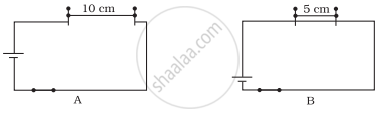
Paheli took a wire of length 10 cm. Boojho took a wire of 5 cm of the same material and thickness. Both of them connected the wires as shown in the circuit given in the following figure. The current flowing in both the circuits is the same.
- Will the heat produced in both cases be equal? Explain.
- Will the heat produced be the same if the wires taken by them are of equal lengths but of different thickness? Explain.
What is an electric fuse made up of?
Assertion: A current-carrying wire should be charged.
Reason: The current in a wire is due to the flow of free electrons in a definite direction.
An electric fuse is a wire made up of a material having ______ melting point.
A fuse is used in an electric circuit to stop high currents flowing through the circuit.
The electric fuse works on the Joule heating principle.
Tara, after completing her exams, went to her grandmother's house along with her younger brother Rahul. One day, Rahul came home after playing and switched on the fan and air conditioner. At the same time, his grandmother was preparing a milkshake for him using a mixer. Suddenly, they heard a big sound and the electricity of the house got shut down. Tara is called an electrician. He said the main reason for supply to shut down was overloading.
- What is overloading?
- Is overloading and short the same? When does short-circuiting take place?
- How can the effects of overloading be avoided?
Write an expression for the amount of heat produced in a resistor when an electric current is passed through it stating the meanings of the symbols used.
When a current I flows through a wire of resistance R for time t then the electrical energy produced is given by ______.
