Advertisements
Advertisements
प्रश्न
An electric heater is connected to the 230 V mains supply. A current of 8 A flows through the heater.
- How much charge flows around the circuit each second?
- How much energy is transferred to the heater each second?
Advertisements
उत्तर
Given: Potential difference = 230 V
Current (I) = 8 A
a. I = `Q/t``
⇒ 8 = Q/1
⇒ Q = 8 × 1
⇒ Q = 8C
Therefore, the charge that flows around the circuit every second is 8 C.
b. We know that,
Energy transferred = Work done
Potential difference = `"Work done"/"Charge moved"`
⇒ 230 = `"Work done"/8`
⇒ Work done = 230 × 8
⇒ Work done = 1840 J
Thus, 1840 joules of energy are transferred to the heater each second.
APPEARS IN
संबंधित प्रश्न
Compute the heat generated while transferring 96000 coulomb of charge in one hour through a potential difference of 50 V.
Why are the conductors of electric heating devices, such as bread-toasters and electric irons, made of an alloy rather than a pure metal?
Explain why, the current that makes the heater element very hot, only slightly warms the connecting wires leading to the heater.
The heat produced in a wire of resistance 'x' when a current 'y' flows through it in time 'z' is given by:
(a) x2 × y × z
(b) x × z × y2
(c) y × z2 × x
(d) y × z × x
Which electric heating device in your home do you think have resistors which control the flow of electricity?
Give Scientific reasons.
In the electric equipment producing heat e.g. iron, electric heater, boiler, toaster etc, an alloy such as Nichrome is used, not pure metals.
Give a scientific reason:
For electric power transmission, copper or aluminium wire is used.
Give Scientific reason.
In practice, the unit kWh is used for the measurement of electrical energy, rather than joule.
Identify the figure and give its use.
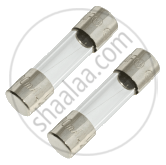
Statement 1 : Electric current ( flow of electrons ) creates heat in the resistor.
Statement 2 : Heat in the resistor is created according to the rule of energy conservation.
Explain Statement 1 with the help of Statement 2.
Rewrite the following statement by selecting the correct option:
1 A = ____________ mA.
Find the odd one out and give its explanation.
(a) Observe the diagram given below and state whether the bulb will glow or not when we switch on K.
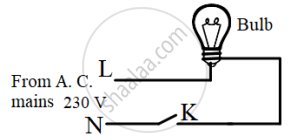
(b) Is it safe to handle the bulb when the switch is OFF?
(c) Give a reason for your answer in (b).
An electric component used as a safety device is electric circuit is ______.
Your teacher has shown you the following activity.
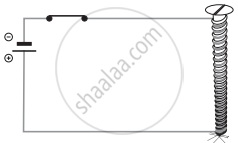
Activity: Teacher has wound a long insulated piece of wire around an iron nail in the form of a coil. Free ends of the wire are connected to a cell through a switch as shown in the following figure. The current is switched on and some pins are placed near the ends of the nail.
Write down any three questions that come to your mind about this activity.
What is an electric fuse made up of?
Explain the working of an electric fuse.
Define the following:
Electrolyte
An electric iron is rated 220 V, 2 kW. If the iron is used for 3h daily find the cost of running it for one week if it costs ₹ 4.25 per kWh.
