Advertisements
Advertisements
Question
An electric heater is connected to the 230 V mains supply. A current of 8 A flows through the heater.
- How much charge flows around the circuit each second?
- How much energy is transferred to the heater each second?
Advertisements
Solution
Given: Potential difference = 230 V
Current (I) = 8 A
a. I = `Q/t``
⇒ 8 = Q/1
⇒ Q = 8 × 1
⇒ Q = 8C
Therefore, the charge that flows around the circuit every second is 8 C.
b. We know that,
Energy transferred = Work done
Potential difference = `"Work done"/"Charge moved"`
⇒ 230 = `"Work done"/8`
⇒ Work done = 230 × 8
⇒ Work done = 1840 J
Thus, 1840 joules of energy are transferred to the heater each second.
APPEARS IN
RELATED QUESTIONS
Name any two effects of electric current.
Give two reasons why nichrome alloy is used for making the heating elements of electrical appliances.
Why does the connecting cord of an electric heater not glow hot while the heating element does?
Explain why, tungsten is used for making the filaments of electric bulbs.
Explain why, the current that makes the heater element very hot, only slightly warms the connecting wires leading to the heater.
The current passing through an electric kettle has been doubled. The heat produced will become:
(a) half
(b) double
(c) four time
(d) one-fourth
The electrical resistivities of four materials P, Q, R and S are given below:
| P | `6.84xx10^8`Ωm |
| Q | `1.70xx10^8`Ωm |
| R | ` 1.0xx10^15`Ωm |
| s | `11.0xx10^-7`Ωm |
Which material will you use for making: (a) heating element of electric iron (b) connecting wires of electric iron (c) covering of connecting wires? Give reason for your choice in each case.
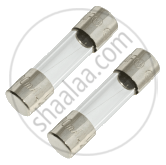
Identify the figure and give its use.
Which of the following substance contracts on heating?
Which of the following is correct?
An electric iron consumes energy at the rate of 420 W when heating is at the maximum rate and 180 W when heating is at the minimum rate. The applied voltage is 220 V. What is the current in each case?
The heating element of an electric iron is made up of:
Name two electric devices for each where
- heating effect of current is used and
- magnetic effect of current is used.
Your teacher has shown you the following activity.
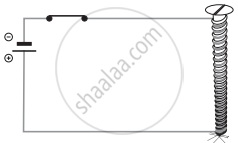
Activity: Teacher has wound a long insulated piece of wire around an iron nail in the form of a coil. Free ends of the wire are connected to a cell through a switch as shown in the following figure. The current is switched on and some pins are placed near the ends of the nail.
Write down any three questions that come to your mind about this activity.
An MCB can be used instead of a fuse in an electrical circuit.
It would cost a man Rs. 3.50 to buy 1.0 kW h of electrical energy from the Main Electricity Board. His generator has a maximum power of 2.0 kW. The generator produces energy at this maximum power for 3 hours. Calculate how much it would cost to buy the same amount of energy from the Main Electricity Board.
Name a few appliances which work on the basis of the heating effect of current.
A trip switch is a ______ safety device.
In a set up the students coated iron nails with zinc metal and noted that, iron nails coated with zinc prevents rusting. They also observed that zinc initially acts as a physical barrier, but an extra advantage of using zinc is that it continues to prevent rusting even if the layer of zinc is damaged. Name this process of rust prevention and give any two other methods to prevent rusting.
What is the heating effect of electric current?
