Advertisements
Advertisements
प्रश्न
Compute the heat generated while transferring 96000 coulomb of charge in one hour through a potential difference of 50 V.
Advertisements
उत्तर
Given Charge, Q = 96000C
Time, t = 1hr = 60 x 60 = 3600s
Potential difference, V= 50volts
Now we know that H = VIt
So we have to calculate I first
As I = `Q/t`
∴ I = `96000/3600`
= `80/3A`
H = V × I × t
By substituting the values,
`50 xx 80/3 xx 60 xx 60`
= 4.8 × 10⁶ J
Therefore, the heat generated is 4.8 × 10⁶ J.
APPEARS IN
संबंधित प्रश्न
An electric iron of resistance 20 Ω takes a current of 5 A. Calculate the heat developed in 30 s.
An electric room heater draws a current of 2.4 A from the 120 V supply line. What current will this room heater draw when connected to 240 V supply line?
Explain why, tungsten is used for making the filaments of electric bulbs.
The heat produced by passing an electric current through a fixed resistor is proportional to the square of:
(a) magnitude of resistance of the resistor
(b) temperature of the resistor
(c) magnitude of current
(d) time for which current is passed
Which of the following characteristic is not suitable for a fuse wire?
(a) thin and short
(b) thick and short
(c) low melting point
(d) higher resistance than rest of wiring
How does the wire in the filament of a light bulb behave differently to the other wires in the circuit when the current flows?
What property of the filament wire accounts for this difference?
Two exactly similar heating resistances are connected (i) in series, and (ii) in parallel, in two different circuits, one by one. If the same current is passed through both the combinations, is more heat obtained per minute when they are connected in series or when they are connected in parallel? Give reason for your answer.
Give Scientific reasons.
In the electric equipment producing heat e.g. iron, electric heater, boiler, toaster etc, an alloy such as Nichrome is used, not pure metals.
Solve the following example.
Two tungsten bulbs of wattage 100 W and 60 W power work on 220 V potential difference. If they are connected in parallel, how much current will flow in the main conductor?
What is the heating effect of electric current?
Which metal is used to make the filament of an electric bulb?
Explain the importance/uses of fuse wire.
When does overloading occur?
Mark the correct choice
- Assertion: Electric appliances with a metallic body have three wire connections.
- Reason: Three-pin connections reduce the heating of the connecting wires.
A fuse wire repeatedly gets burnt when used with a good heater. It is advised to use a fuse wire of:
A current of 1 A is drawn by a filament of an electric bulb. Number of electrons passing through a cross-section of the filament in 16 seconds would be roughly:
An electric cell produces electricity from the ______ ______ in it.
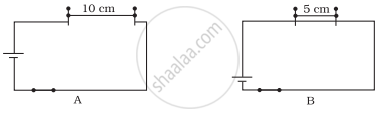
Paheli took a wire of length 10 cm. Boojho took a wire of 5 cm of the same material and thickness. Both of them connected the wires as shown in the circuit given in the following figure. The current flowing in both the circuits is the same.
- Will the heat produced in both cases be equal? Explain.
- Will the heat produced be the same if the wires taken by them are of equal lengths but of different thickness? Explain.
State the law that explains the heating effect of current with respect to the measurable properties in an electrical circuit.
