Advertisements
Advertisements
प्रश्न
(a) Observe the diagram given below and state whether the bulb will glow or not when we switch on K.
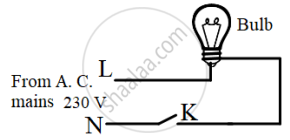
(b) Is it safe to handle the bulb when the switch is OFF?
(c) Give a reason for your answer in (b).
Advertisements
उत्तर
- In the given figure it is observed that the bulb is connected with Live wire and the key is connected with Neutral wire. When the key or switch is ON, the path of current flow is completed, hence the bulb will glow.
- It is NOT safe to handle the bulb when the switch is OFF as bulb is directly connected to live wire.
- In the OFF position, the bulb remains connected to the high potential terminal through the live wire, but no current flows through the bulb, as the return path is incomplete. In this condition, it is not safe to touch the bulb even from outside. As a result, if the switch is connected to the neutral wire, it might be deceiving and even harmful to the user.
APPEARS IN
संबंधित प्रश्न
An electric heater is connected to the 230 V mains supply. A current of 8 A flows through the heater.
(b) How much energy is transferred to the heater each second?
What is nichrome? State its one use.
An electric kettle rated at 220 V, 2.2 kW, works for 3 hours. Find the energy consumed and the current drawn.
Write two devices based on the heating effect of electric current.
Explain the heating effect of electric current.
Which of the following gases are filled in electric bulbs?
Why is parallel arrangement used in domestic wiring?
An electric component used as a safety device is electric circuit is ______.
An MCB can be used instead of a fuse in an electrical circuit.
Tara, after completing her exams, went to her grandmother's house along with her younger brother Rahul. One day, Rahul came home after playing and switched on the fan and air conditioner. At the same time, his grandmother was preparing a milkshake for him using a mixer. Suddenly, they heard a big sound and the electricity of the house got shut down. Tara is called an electrician. He said the main reason for supply to shut down was overloading.
- What is overloading?
- Is overloading and short the same? When does short-circuiting take place?
- How can the effects of overloading be avoided?
