Advertisements
Advertisements
प्रश्न
Give a scientific reason.
Tungsten metal is used to make a solenoid type coil in an electric bulb.
Advertisements
उत्तर १
- The electric bulb operates under the principle of the heating effect of electric current.
- The bulb’s solenoid-type coil has a very high melting point and high resistance.
- The solenoid-type coil of the lightbulb becomes heated to a high temperature (up to 3400°C) and begins to shine when current is delivered through it.
As a result, tungsten metal creates a solenoid-type coil in an electric bulb.
उत्तर २
- The temperature of a bulb’s filament determines how much light it emits. It rises as the temperature does.
- The material used to construct a lightbulb's filament should have a very high melting point so that it can be heated to a high temperature by running a current through it without melting. We are able to get more light as a result. Tungsten has an extremely high melting point. It is possible to heat tungsten wire to around 3400°C.
Hence, tungsten is used to make a solenoid type coil (filament) in an electric bulb.
APPEARS IN
संबंधित प्रश्न
An electric heater of resistance 8 Ω draws 15 A from the service mains 2 hours. Calculate the rate at which heat is developed in the heater.
Why is a series arrangement not used for connecting domestic electrical appliances in a circuit?
Explain why, the current that makes the heater element very hot, only slightly warms the connecting wires leading to the heater.
The current passing through an electric kettle has been doubled. The heat produced will become:
(a) half
(b) double
(c) four time
(d) one-fourth
An electric fuse works on the:
(a) chemical effect of current
(b) magnetic effect of current
(c) lighting effect of current
(d) heating effect of current
The electrical resistivities of four materials P, Q, R and S are given below:
| P | `6.84xx10^8`Ωm |
| Q | `1.70xx10^8`Ωm |
| R | ` 1.0xx10^15`Ωm |
| s | `11.0xx10^-7`Ωm |
Which material will you use for making: (a) heating element of electric iron (b) connecting wires of electric iron (c) covering of connecting wires? Give reason for your choice in each case.
Identify the figure and give its use.
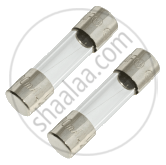
An electric iron of 1100 W is operated for 2 hrs daily. What will be the electrical consumption expenses for that in the month of April? (The electric company charges Rs 5 per unit of energy).
Statement 1 : Electric current ( flow of electrons ) creates heat in the resistor.
Statement 2 : Heat in the resistor is created according to the rule of energy conservation.
Explain Statement 1 with the help of Statement 2.
Rewrite the following statement by selecting the correct option:
1 A = ____________ mA.
The ‘live’ and the ‘neutral’ wires have potential difference of _______.
Which of the following substance contracts on heating?
Which metal is used to make the filament of an electric bulb?
What is a short circuit?
What is used to turn off the sudden increase in current in the electrical circuit of the house nowadays?
An electric iron consumes energy at the rate of 420 W when heating is at the maximum rate and 180 W when heating is at the minimum rate. The applied voltage is 220 V. What is the current in each case?
An electric iron draws a current of 4 A when connected to 220 V mains. Its resistance must be:
A fuse wire repeatedly gets burnt when used with a good heater. It is advised to use a fuse wire of:
An electric kettle consumes 1 kW of electric power when operated at 220 V. A fuse wire of what rating must be used for it?
An electric component used as a safety device is electric circuit is ______.
Name two electric devices for each where
- heating effect of current is used and
- magnetic effect of current is used.
What are the uses of electromagnets?
It would cost a man Rs. 3.50 to buy 1.0 kW h of electrical energy from the Main Electricity Board. His generator has a maximum power of 2.0 kW. The generator produces energy at this maximum power for 3 hours. Calculate how much it would cost to buy the same amount of energy from the Main Electricity Board.
Copper wire offers very little ______ and does not get heated up quickly.
Match the following
| 1. | Bulb | a. | Conductor |
| 2. | Electroplating | b. |
Insulator |
| 3. | Pure water | c. | Heating effect of current |
| 4. | Salt solution | d. | Chemical effect of current |
Name the effect of the current responsible for the glow of the bulb in an electrical circuit.
Name a few appliances which work on the basis of the heating effect of current.
An electric fuse is a wire made up of a material having ______ melting point.
An electrochemical cell converts ______ energy into ______ energy.
Explain why fuse wire is always connected in a series arrangement.
In the electric equipment producing heat like iron, electric heater, boiler, toaster etc., an alloy such as nichrome is used, not pure metals.
An electric kettle of 2 kW is used for 2h. Calculate the energy consumed in
- kilowatt hour and
- joules.
Write an expression for the amount of heat produced in a resistor when an electric current is passed through it stating the meanings of the symbols used.
Anannya responded to the question: Why do electrical appliances with metallic bodies are connected to the mains through a three-pin plug, whereas an electric bulb can be connected with a two-pin plug?
She wrote: Three-pin connections reduce heating of connecting wires.
- Is her answer correct or incorrect? Justify.
- What is the function of a fuse in a domestic circuit?
An electric iron is rated 220 V, 2 kW. If the iron is used for 3h daily find the cost of running it for one week if it costs ₹ 4.25 per kWh.
