Advertisements
Advertisements
प्रश्न
Give a scientific reason.
Tungsten metal is used to make a solenoid type coil in an electric bulb.
Advertisements
उत्तर १
- The electric bulb operates under the principle of the heating effect of electric current.
- The bulb’s solenoid-type coil has a very high melting point and high resistance.
- The solenoid-type coil of the lightbulb becomes heated to a high temperature (up to 3400°C) and begins to shine when current is delivered through it.
As a result, tungsten metal creates a solenoid-type coil in an electric bulb.
उत्तर २
- The temperature of a bulb’s filament determines how much light it emits. It rises as the temperature does.
- The material used to construct a lightbulb's filament should have a very high melting point so that it can be heated to a high temperature by running a current through it without melting. We are able to get more light as a result. Tungsten has an extremely high melting point. It is possible to heat tungsten wire to around 3400°C.
Hence, tungsten is used to make a solenoid type coil (filament) in an electric bulb.
APPEARS IN
संबंधित प्रश्न
An electric heater of resistance 8 Ω draws 15 A from the service mains 2 hours. Calculate the rate at which heat is developed in the heater.
Why is the tungsten used almost exclusively for filament of electric lamps?
Why are the conductors of electric heating devices, such as bread-toasters and electric irons, made of an alloy rather than a pure metal?
How does the resistance of a wire vary with its area of cross-section?
An electric heater is connected to the 230 V mains supply. A current of 8 A flows through the heater.
(b) How much energy is transferred to the heater each second?
Why does the connecting cord of an electric heater not glow hot while the heating element does?
Derive the expression for the heat produced due to a current 'I' flowing for a time interval 't' through a resistor 'R' having a potential difference 'V' across its ends. With which name is this relation known?
The heat produced by passing an electric current through a fixed resistor is proportional to the square of:
(a) magnitude of resistance of the resistor
(b) temperature of the resistor
(c) magnitude of current
(d) time for which current is passed
If the current flowing through a fixed resistor is halved, the heat produced in it will become:
Three heaters each rated 250 W, 100 V are connected in parallel to a 100 V supply. Calculate:
- the total current taken from the supply
- the resistance of each heater and
- the energy supplied in kWh to the three heaters in 5 hours.
Identify the figure and give its use.
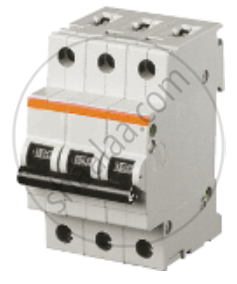
An electric iron of 1100 W is operated for 2 hrs daily. What will be the electrical consumption expenses for that in the month of April? (The electric company charges Rs 5 per unit of energy).
Name any six domestic appliances based on the heating effect of electric current.
The electricity bill specifies the usage in _______.
A coil of an alloy _______ is used in electric heater cooker as a resistor.
What is used to turn off the sudden increase in current in the electrical circuit of the house nowadays?
Right or wrong sentence.
Live wire and neutral wires have a 220 V potential difference.
Write scientific reason.
A coil made up of alloy Nichrome is used in the electric heater cooker as a resistor.
Name any two appliances which works on the phenomenon of heating effect of electric current.
Explain the importance/uses of fuse wire.
Explain the application of heating effect of electric current in an electric bulb with a diagram.
True or False – If False give the correct answer
The fuse wire does not melts whenever there is overload in the wiring.
A current of 1 A is drawn by a filament of an electric bulb. Number of electrons passing through a cross-section of the filament in 16 seconds would be roughly:
Why is parallel arrangement used in domestic wiring?
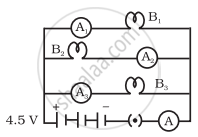
B1, B2 and B3 are three identical bulbs connected as shown in Figure. When all the three bulbs glow, a current of 3A is recorded by the ammeter A.
- What happens to the glow of the other two bulbs when the bulb B1 gets fused?
- What happens to the reading of A1, A2, A3 and A when the bulb B2 gets fused?
- How much power is dissipated in the circuit when all the three bulbs glow together?
(a) Observe the diagram given below and state whether the bulb will glow or not when we switch on K.
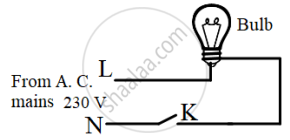
(b) Is it safe to handle the bulb when the switch is OFF?
(c) Give a reason for your answer in (b).
An electric component used as a safety device is electric circuit is ______.
Can we use the same fuse in a geyser and a television set? Explain.
An MCB can be used instead of a fuse in an electrical circuit.
Explain the working of an electric fuse.
______ wire is used in the filament of the bulbs.
Tara, after completing her exams, went to her grandmother's house along with her younger brother Rahul. One day, Rahul came home after playing and switched on the fan and air conditioner. At the same time, his grandmother was preparing a milkshake for him using a mixer. Suddenly, they heard a big sound and the electricity of the house got shut down. Tara is called an electrician. He said the main reason for supply to shut down was overloading.
- What is overloading?
- Is overloading and short the same? When does short-circuiting take place?
- How can the effects of overloading be avoided?
In a set up the students coated iron nails with zinc metal and noted that, iron nails coated with zinc prevents rusting. They also observed that zinc initially acts as a physical barrier, but an extra advantage of using zinc is that it continues to prevent rusting even if the layer of zinc is damaged. Name this process of rust prevention and give any two other methods to prevent rusting.
What is the heating effect of electric current?
The graph of voltage vs current for four different materials is shown below.

Which of these four materials would be used for making filament of bulb?
