Advertisements
Advertisements
प्रश्न
An electric heater of resistance 8 Ω draws 15 A from the service mains 2 hours. Calculate the rate at which heat is developed in the heater.
Advertisements
उत्तर
Resistance of the electric heater, R = 8 Ω
Current I = 15 A
Time, t = 2 hr.
Rate of generation of heat = I2 × R
= (15)2 × 8
= 255 × 8
= 1800 W
Therefore, heat is produced by the heater at a rate of 1800 W.
APPEARS IN
संबंधित प्रश्न
Why does the cord of an electric heater not glow while the heating element does?
How does the resistance of a wire vary with its area of cross-section?
What is nichrome? State its one use.
Why is a series arrangement not used for connecting domestic electrical appliances in a circuit?
An electric iron of resistance 20 ohms draws a current of 5 amperes. Calculate the heat produced in 30 seconds.
Derive the expression for the heat produced due to a current 'I' flowing for a time interval 't' through a resistor 'R' having a potential difference 'V' across its ends. With which name is this relation known?
What is meant by the heating effect of current?
The electrical resistivities of four materials P, Q, R and S are given below:
| P | `6.84xx10^8`Ωm |
| Q | `1.70xx10^8`Ωm |
| R | ` 1.0xx10^15`Ωm |
| s | `11.0xx10^-7`Ωm |
Which material will you use for making: (a) heating element of electric iron (b) connecting wires of electric iron (c) covering of connecting wires? Give reason for your choice in each case.
Two exactly similar heating resistances are connected (i) in series, and (ii) in parallel, in two different circuits, one by one. If the same current is passed through both the combinations, is more heat obtained per minute when they are connected in series or when they are connected in parallel? Give reason for your answer.
Which electric heating device in your home do you think have resistors which control the flow of electricity?
Give Scientific reasons.
In the electric equipment producing heat e.g. iron, electric heater, boiler, toaster etc, an alloy such as Nichrome is used, not pure metals.
Identify the figure and give its use.
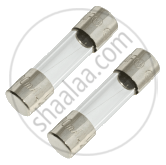
The heating element of an electric iron is made up of:
An MCB can be used instead of a fuse in an electrical circuit.
An electric fuse has a body made of ceramic and two points for connecting the fuse wire.
Match the following
| 1. | Bulb | a. | Conductor |
| 2. | Electroplating | b. |
Insulator |
| 3. | Pure water | c. | Heating effect of current |
| 4. | Salt solution | d. | Chemical effect of current |
Name the effect of the current responsible for the glow of the bulb in an electrical circuit.
A student boils water in an electric kettle for 20 minutes. Using the same mains supply he wants to reduce the boiling time of water. To do so should he increase or decrease the length of the heating element? Justify your answer.
Tara, after completing her exams, went to her grandmother's house along with her younger brother Rahul. One day, Rahul came home after playing and switched on the fan and air conditioner. At the same time, his grandmother was preparing a milkshake for him using a mixer. Suddenly, they heard a big sound and the electricity of the house got shut down. Tara is called an electrician. He said the main reason for supply to shut down was overloading.
- What is overloading?
- Is overloading and short the same? When does short-circuiting take place?
- How can the effects of overloading be avoided?
When a current I flows through a wire of resistance R for time t then the electrical energy produced is given by ______.
