Advertisements
Advertisements
प्रश्न
What is Joule’s heating effect? How can it be demonstrated experimentally? List its four applications in daily life.
Advertisements
उत्तर
Joule's law of heating states that heat produced in the resistor is
- directly proportional to the square of the current.
- directly proportional to the resistance.
- directly proportional to the current.
Mathematically,
H = i2Rt
where,
H = Heat produced
I = Current
R = Resistance
t = time
Experimental demonstration
- Take a water heating immersion rod, water, bucket, thermometer, regulator.
- Immerse the water heating immersion rod in the water and measure the time taken to heat the water upto a certain temperature.
- Now increase the current to double with the help of regulator and now measure the time taken to heat the water upto the same temperature.
Then, we will observe that time taken in second case will be one fourth the time taken in earlier case. Hence, it verifies the Joule's law of heating.
Electric fuse, toaster, oven, kettle, are the four applications of Joule's law of heating in daily life.
APPEARS IN
संबंधित प्रश्न
Name any two effects of electric current.
Give two reasons why nichrome alloy is used for making the heating elements of electrical appliances.
Explain why, the current that makes the heater element very hot, only slightly warms the connecting wires leading to the heater.
An electric iron is connected to the mains power supply of 220 V. When the electric iron is adjusted at ‘minimum heating' it consumes a power of 360 W but at 'maximum heating’ it takes a power of 840 W. Calculate the current and resistance in each case.
Why does tungsten metal used to make solenoid type coil in an electric bulb?
Name the factors on which the heat produced in a wire depends when current is passed in it, and state how does it depend on the factors stated by you.
What is overloading?
Write scientific reason.
A coil made up of alloy Nichrome is used in the electric heater cooker as a resistor.
Explain the importance/uses of fuse wire.
How can overloading be avoided?
Explain the heating effect of electric current.
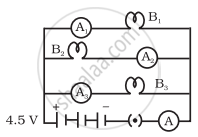
B1, B2 and B3 are three identical bulbs connected as shown in Figure. When all the three bulbs glow, a current of 3A is recorded by the ammeter A.
- What happens to the glow of the other two bulbs when the bulb B1 gets fused?
- What happens to the reading of A1, A2, A3 and A when the bulb B2 gets fused?
- How much power is dissipated in the circuit when all the three bulbs glow together?
An MCB can be used instead of a fuse in an electrical circuit.
What is an electric fuse made up of?
______ wire is used in the filament of the bulbs.
1 kWh is equal to ______.
In a set up the students coated iron nails with zinc metal and noted that, iron nails coated with zinc prevents rusting. They also observed that zinc initially acts as a physical barrier, but an extra advantage of using zinc is that it continues to prevent rusting even if the layer of zinc is damaged. Name this process of rust prevention and give any two other methods to prevent rusting.
State the law that explains the heating effect of current with respect to the measurable properties in an electrical circuit.
Anannya responded to the question: Why do electrical appliances with metallic bodies are connected to the mains through a three-pin plug, whereas an electric bulb can be connected with a two-pin plug?
She wrote: Three-pin connections reduce heating of connecting wires.
- Is her answer correct or incorrect? Justify.
- What is the function of a fuse in a domestic circuit?
The graph of voltage vs current for four different materials is shown below.

Which of these four materials would be used for making filament of bulb?
