Advertisements
Advertisements
प्रश्न
Name any two appliances which works on the phenomenon of heating effect of electric current.
Advertisements
उत्तर
Fuse wire, electric iron, electric bulb, electric cooker, geyser.
APPEARS IN
संबंधित प्रश्न
How does the resistance of a wire vary with its area of cross-section?
When current is switched ‘on’ in a room heater, it ______.
Give two reasons why nichrome alloy is used for making the heating elements of electrical appliances.
Explain why, tungsten is used for making the filaments of electric bulbs.
How much heat will an instrument of 12 W produce in one minute if it is connected to the heat produced by it?
The heat produced by passing an electric current through a fixed resistor is proportional to the square of:
(a) magnitude of resistance of the resistor
(b) temperature of the resistor
(c) magnitude of current
(d) time for which current is passed
Which of the following characteristic is not suitable for a fuse wire?
(a) thin and short
(b) thick and short
(c) low melting point
(d) higher resistance than rest of wiring
Which electric heating device in your home do you think have resistors which control the flow of electricity?
Three heaters each rated 250 W, 100 V are connected in parallel to a 100 V supply. Calculate:
- the total current taken from the supply
- the resistance of each heater and
- the energy supplied in kWh to the three heaters in 5 hours.
Give scientific reason :
In the electric equipment producing heat e.g. iron, electric heater, boiler, toaster, etc., an alloy such as Nichrome is used, not pure metals.
Write the mathematical expression for Joule’s law of heating.
In an electric bulb, coil of _______ metal is used.
A coil of an alloy _______ is used in electric heater cooker as a resistor.
What does overloading cause?
Explain the application of heating effect of electric current in an electric bulb with a diagram.
True or False – If False give the correct answer
The fuse wire does not melts whenever there is overload in the wiring.
Which of the following is correct?
Mark the correct choice
- Assertion: Electric appliances with a metallic body have three wire connections.
- Reason: Three-pin connections reduce the heating of the connecting wires.
An electric iron consumes energy at the rate of 420 W when heating is at the maximum rate and 180 W when heating is at the minimum rate. The applied voltage is 220 V. What is the current in each case?
A fuse wire repeatedly gets burnt when used with a good heater. It is advised to use a fuse wire of:
A current of 1 A is drawn by a filament of an electric bulb. Number of electrons passing through a cross-section of the filament in 16 seconds would be roughly:
An electric bulb is connected to a 220 V generator. The current is 0.50 A. What is the power of the bulb?
An electric kettle consumes 1 kW of electric power when operated at 220 V. A fuse wire of what rating must be used for it?
How does use of a fuse wire protect electrical appliances?
Why is parallel arrangement used in domestic wiring?
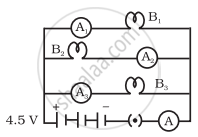
B1, B2 and B3 are three identical bulbs connected as shown in Figure. When all the three bulbs glow, a current of 3A is recorded by the ammeter A.
- What happens to the glow of the other two bulbs when the bulb B1 gets fused?
- What happens to the reading of A1, A2, A3 and A when the bulb B2 gets fused?
- How much power is dissipated in the circuit when all the three bulbs glow together?
When a switch is in OFF position,
- circuit starting from the positive terminal of the cell stops at the switch.
- circuit is open.
- no current flows through it.
- current flows after some time.
Choose the combination of correct answer from the following.
An electric cell produces electricity from the ______ ______ in it.
Unscramble the following words:
SFEU
What are the uses of electromagnets?
Explain the working of an electric fuse.
Match the following
| 1. | Bulb | a. | Conductor |
| 2. | Electroplating | b. |
Insulator |
| 3. | Pure water | c. | Heating effect of current |
| 4. | Salt solution | d. | Chemical effect of current |
Assertion: A current-carrying wire should be charged.
Reason: The current in a wire is due to the flow of free electrons in a definite direction.
Name the effect of the current responsible for the glow of the bulb in an electrical circuit.
A trip switch is a ______ safety device.
Explain why fuse wire is always connected in a series arrangement.
In the electric equipment producing heat like iron, electric heater, boiler, toaster etc., an alloy such as nichrome is used, not pure metals.
An electric kettle consumes 1 kW of electric power when operated at 220 V. A fuse wire of what rating must be used for it?
What is the heating effect of electric current?
