Advertisements
Advertisements
प्रश्न
Why is a series arrangement not used for connecting domestic electrical appliances in a circuit?
Advertisements
उत्तर
A series arrangement is not used for connecting domestic electrical appliances because different appliances have different resistances; this leads to the problem of unequal voltage distribution. Another reason why this arrangement is not preferred is that if one of the appliances gets damaged, the power supply to all other appliances is cut off.
APPEARS IN
संबंधित प्रश्न
An electric iron of resistance 20 Ω takes a current of 5 A. Calculate the heat developed in 30 s.
How does the resistance of a wire vary with its area of cross-section?
The safety device based on the heating effect of electric current is called a ______.
What is nichrome? State its one use.
Why does the connecting cord of an electric heater not glow hot while the heating element does?
The current passing through an electric kettle has been doubled. The heat produced will become:
(a) half
(b) double
(c) four time
(d) one-fourth
Which electric heating device in your home do you think have resistors which control the flow of electricity?
An electric iron of 1100 W is operated for 2 hrs daily. What will be the electrical consumption expenses for that in the month of April? (The electric company charges Rs 5 per unit of energy).
Name any six domestic appliances based on the heating effect of electric current.
An electric iron consumes energy at the rate of 420 W when heating is at the maximum rate and 180 W when heating is at the minimum rate. The applied voltage is 220 V. What is the current in each case?
Unscramble the following words:
SFEU
Can we use the same fuse in a geyser and a television set? Explain.
Your teacher has shown you the following activity.
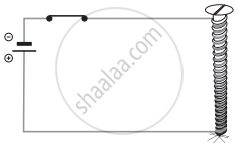
Activity: Teacher has wound a long insulated piece of wire around an iron nail in the form of a coil. Free ends of the wire are connected to a cell through a switch as shown in the following figure. The current is switched on and some pins are placed near the ends of the nail.
Write down any three questions that come to your mind about this activity.
A student boils water in an electric kettle for 20 minutes. Using the same mains supply he wants to reduce the boiling time of water. To do so should he increase or decrease the length of the heating element? Justify your answer.
Two students decided to investigate the effect of water and air on iron object under identical experimental conditions. They measured the mass of each object before placing it partially immersed in 10 ml of water. After a few days, the object were removed, dried and their masses were measured. The table shows their results.
| Student | Object | Mass of Object before Rusting in g |
Mass of the coated object in g |
| A | Nail | 3.0 | 3.15 |
| B | Thin plate | 6.0 | 6.33 |
What might be the reason for the varied observations of the two students?
Write an expression for the amount of heat produced in a resistor when an electric current is passed through it stating the meanings of the symbols used.
State the law that explains the heating effect of current with respect to the measurable properties in an electrical circuit.
