Advertisements
Advertisements
प्रश्न
Draw a circuit diagram to show how two 4 V electric lamps can be lit brightly from two 2 V cells.
Advertisements
उत्तर
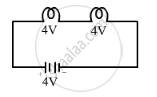
APPEARS IN
संबंधित प्रश्न
If 20 C of charge pass a point in a circuit in 1 s, what current is flowing?
If the amount of electric charge passing through a conductor in 10 minutes is 300 C, the current flowing is:
(a) 30 A
(b) 0.3 A
(c) 0.5 A
(d) 5 A
An electric circuit consisting of a 0.5 m long nichrome wire XY, an ammeter, a voltmeter, four cells of 1.5 V each and a plug key was set up.
Following graph was plotted between V and I values:
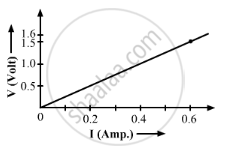
What would be the values of `V/I` rations when the potential difference is 0.8 V, 1.2 V and 1.6 V respectively?
What conclusion do you draw from these values?
What is the resistance of the wire?
Which type of circuit, series or parallel, is preferred while connecting a large number of bulbs:
(b) for lighting inside the rooms of the hotel?
Name two effects produced by electric current.
Which effect of current is utilised in an electric light bulb?
A wire of length 5 m has a resistance of 2.0 Ω calculate:
(a) the resistance of wire of length 1 m
(b) the equivalent resistance if two such wires each of length 2 m are joined in parallel.
(c) the resistance of 1 m length of wire of same material but of half diameter.
A cell supplies a current of 1.2 A through two 2 Ω resistors connected in parallel. When the resistors are connected in series, it supplies a current of 0.4 A. Calculate:
(i) the internal resistance and (ii) e.m.f. of the cell.
Complete the following sentence:
Fuse wire has a ............ Melting point and it is made of an alloy of ......... and if the current in a circuit rises too high, the fuse wire ...........
Tick(✓) the correct choice in the following:
When the length of a conductor is doubled the resistance of the conductor
will
How is direction of current related to the direction of flow of electrons?
What is meant by internal resistance of a cell?
Calculate the current in a wire if a charge of 1500 coulomb flows through it in 5 minutes.
In electrolytes, the ions carrying charge move toward:
Common sources of Alternating Current (AC) are:
Electric current flows through a circuit only when:
A charge of 20 C flows through a conductor in 4 s. The electric current through the conductor is:
