Advertisements
Advertisements
प्रश्न
The diagram below shows a cooling curve for 200 g of water. The heat is extracted at the rate of 100 Js-1. Answer the questions that follow:
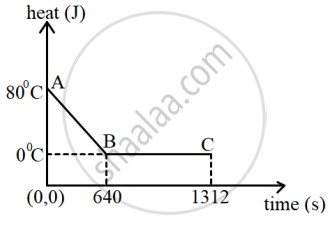
- Calculate specific heat capacity of water.
- Heat released in the region BC.
Advertisements
उत्तर
(a) mass of water (m) = 200 g = 0.2 kg.
Rate of heat extraction= 100 J/s.
So, total heat extracted for curve AB is = 100 × 640 = 64000 J
Now, for curve AB we can write,
64000 = 0.2 × Cp × (353 - 273) ...`[(80^circ "C" = 273 + 80 = 353;),(0^circ "C" = 273 + 0 = 273 "K")]`
Solving we get,
C = 4000 Jkg-1 K-1
Thus, the specific heat capacity of water is 4000 Jkg-1 K-1.
(b) From the figure it is clear that at point Band C is corresponds to time 640 sand 1312 s, respectively. Thus, heat released in region BC is = 100 × (1312 - 640) = 67,200 J
APPEARS IN
संबंधित प्रश्न
Heat supplied to a solid change it into liquid. What is this change in the phase called?
Two metallic blocks P and Q of masses in ratio 2: 1 are given the same amount of heat. If their temperature rise by the same amount, compare their specific heat capacities.
How will rise in sea level affect population in coastal countries?
Equal heat is given to two objects A and B of mass 1 g. Temperature of A increases by 3°C and B by 5°C. Which object has more specific heat? And by what factor?
Why is specific heat capacity taken as a measure of thermal inertia?
Explain, why water is considered as best liquid for quenching thirst?
Explain, why does a wise farmer water his fields, if forecast is forst?
1 kg of water freezes to form ice at 0°C. What amount of heat is withdrawn?
An office room contains about 4000 moles of air. The change in the internal energy of this much air when it is cooled from 34° C to 19° C at a constant pressure of 1.0 atm is (Use `gamma_"air"` = 1.4 and Universal gas constant = 8.314 J / mol K) ____________.
