Advertisements
Advertisements
प्रश्न
What is the specific heat capacity of boiling water?
Advertisements
उत्तर
The specific heat capacity of boiling water is 0.46 cal/g-oC or 1926 J/kg-K.
APPEARS IN
संबंधित प्रश्न
A child running a temperature of 101°F is given an antipyrin (i.e. a medicine that lowers fever) which causes an increase in the rate of evaporation of sweat from his body. If the fever is brought down to 98 °F in 20 min, what is the average rate of extra evaporation caused, by the drug? Assume the evaporation mechanism to be the only way by which heat is lost. The mass of the child is 30 kg. The specific heat of human body is approximately the same as that of water, and latent heat of evaporation of water at that temperature is about 580 cal g–1.
A liquid X has the maximum specific heat capacity and is used as a coolant in Car Radiators. Name the liquid X.
Heat supplied to a solid change it into liquid. What is this change in the phase called?
Differentiate between heat capacity and specific heat capacity.
What do you mean by the following statement?
The specific heat capacity of copper is 0. 4 Jg-1 K-1?
Water property of water makes it an effective coolant?
How does green house effect help in keeping the temperature of earth’s surface suitable for living of human beings?
Give three reasons for the increase of green house gases.
State the effect of enhancement of green house effect.
How will rise in sea level affect population in coastal countries?
Equal heat is given to two objects A and B of mass 1 g. Temperature of A increases by 3°C and B by 5°C. Which object has more specific heat? And by what factor?
Study the following procedure and answer the questions below:
1. Take 3 spheres of iron, copper and lead of equal mass.
2. Put all the 3 spheres in boiling water in a beaker for some time.
3. Take 3 spheres out of the water. Put them immediately on a thick slab of wax.
4. Note, the depth that each sphere goes into the wax.
i) Which property of substance can be studied with this procedure?
ii) Describe that property in minimum words.
iii) Explain the rule of heat exchange with this property.
The ratio of specific heat capacity to molar heat capacity of a body _____________ .
What change in heat energy occurs when lead at its melting point
solidifies without change in the temperature?
Define heat capacity.
Write two advantages of high specific heat capacity of water.
The farmers fill their fields with water in winter. Give reason.
Give two reasons as to why copper is preferred over other metals for making calorimeters.
Discuss how high specific heat capacity of water helps in formation of land and sea breeze.
Will the value of specific heat’capacity and specific latent heat of a substance change if the scale is °F instead of °C?
Water falls from a height of 50 m. Calculate the rise in the temperature of water when it strikes the bottom.
(g = 10 ms-2; Specific heat capacity of water = 4200 J / kg°C)
An electric immersion heater is rated 1250 W. Calculate the time in which it will heat 20 kg of water at 5°C to 65°C.
Solve the following problem.
Specific latent heat of vaporization of water is 2.26 × 10⁶ J/kg. Calculate the energy needed to change 5.0 g of water into steam at 100 ºC.
From the options given below the specific heat of _______ is maximum.
Write a short note.
Specific heat capacity
The heat capacity of the vessel of mass 100 kg is 8000 J/°K. Find its specific heat capacity.
Explain why the specific heat capacity at constant pressure is greater than the specific heat capacity at constant volume.
For a gas, `"R"/"C"_"v"=0.4`, where R Is universal gas constant and Cv is the molar specific heat at constant volume. The gas is made up of molecules, which are ______
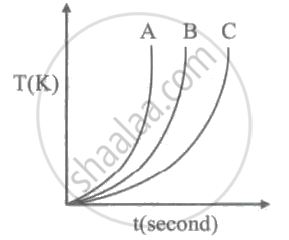
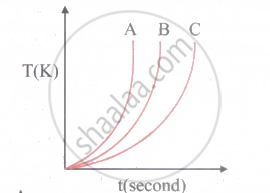
Which of the following substances (A, B and C) has the highest specific beat?
Two uniform brass rods A and B of length land 2l and radii 2r and r respectively are heated to the same temperature. The ratio of the increase in the volume ofB to that of A is ____________.
The value of 'γ' for a gas is given as `gamma = 1 + 2/"f"`, where 'f ' is the number of degrees of freedom of freedom of a molecule of a gas. What is the ratio of `gamma_"monoatonic"//gamma_"diatomic"`?
Diatomic gas consists of rigid gas molecules
Heat is applied to a rigid diatomic gas at constant pressure. The ratio ΔQ : ΔU : ΔW is ______.
The ratio of the specific heats `c_"p"/c_"v"=gamma` in terms of degrees of freedom 'n' is given by ______.
Two metals A and B have specific heat capacities in the ratio 2:3. If they are supplied same amount of heat then
Which metal piece will have greater mass if the rise in temperature is the same for both metals?
Which of the following substances (A, B and C) has the highest specific heat?
A mixture of one mole of monoatomic gas and one mole of a diatomic gas (rigid) are kept at room temperature (27°C). The ratio of specific heat of gases at constant volume respectively is:
