Advertisements
Advertisements
प्रश्न
A certain amount of heat Q will warm 1 g of material X by 3°C and 1 g of material Y by 4°C. Which material has a higher specific heat capacity?
Advertisements
उत्तर
We know that heat Q warms 1 g of material X by 3°C. Therefore, substituting these values in a specific heat formula, we get:
Q = 1 × Cx × 3 ...(1)
Similarly, heat Q warms 1 g of material Y by 4°C, therefore
Q = 1 × Cx × 4 ...(2)
As the same heat Q is provided to both materials, the left-hand side of equations (1) and (2) are the same. Hence, on comparing the right-hand sides, we get,
3Cx = 4Cy
Cx = `4/3`Cy and
Cy = `3/4`Cx
Hence, material X has greater specific heat than material Y. It is because its temperature rises less than Y for the mass amount of heat.
संबंधित प्रश्न
How will rise in sea level affect population in coastal countries?
Write an expression for the heat energy liberated by a hot body.
1 kg of water freezes to form ice at 0°C. What amount of heat is withdrawn?
A piece of iron of mass 2.0 kg has a thermal capacity of 966 J/°C. What is its specific heat capacity in S.I. units?
The SI unit of specific heat is _______.
Which of the following substances (A, B and C) has the highest specific beat?
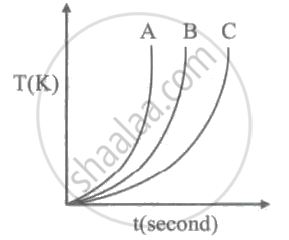
Observe the following diagram and answer the questions given below:

Specific heat capacity of metals
- Which element has maximum specific heat capacity? Justify.
- Which element has minimum specific heat capacity? Justify.
- Define specific heat of object.
