Advertisements
Advertisements
प्रश्न
Specific heat capacity of a substance A is 3.8 J g-1 K-1 and of substance B is 0.4 J g-1 k-1. Which substance is a good conductor of heat? How did you arrive at your conclusion?
Advertisements
उत्तर
The specific heat capacity of substance B is lesser than that of A. So, for same mass and same heat energy, the rise in temperature for B will be more than that of A. Hence, substance B is a good conductor of heat.
APPEARS IN
संबंधित प्रश्न
Water in lakes and ponds do not freeze at once in cold countries. Give a reason is support of your answer.
A substance is heated at a constant rate from a low temperature to a high temperature. A graph of temperature against time is shown in the figure. Which part or parts of the graph correspond(s) to the substance existing in two states?
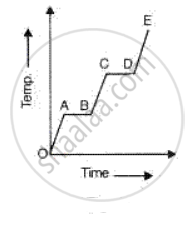
State the condition for the flow of heat energy from one body to another.
Calculate the ratio of two specific heats of polyatomic gas molecules.
Derive Mayer’s relation.
Derive Meyer’s relation for an ideal gas.
50 g of copper is heated to increase its temperature by 10° C. If the same quantity of heat is given to 5 g water, the rise in its temperature is [Specific heat of copper = 420 joule-kg-1 °C-1 , specific heat of water = 4200 joule-kg-I °C-1]
Find the odd one out:
The difference between the two molar specific heats of gas is 9000 J/kg K. If the ratio of the two specific heats is 1.5, calculate the two molar specific heats.
