Advertisements
Advertisements
प्रश्न
The difference between the two molar specific heats of gas is 9000 J/kg K. If the ratio of the two specific heats is 1.5, calculate the two molar specific heats.
Advertisements
उत्तर
Given,
Cp - Cv = 9000 J/kg K
`"C"_"p"/"C"_"v" = 1.5`
Cv = ?
Cp = ?
`"C"_"p"/"C"_"v" = 1.5`
`"C"_"p" = 1.5 " C"_"v"`
`"C"_"p" - "C"_"v" = 9000`
`1.5 " C"_"v" - "C"_"v" = 9000`
`0.5 " C"_"v" = 9000`
`therefore "C"_"v" = 9000/0.5`
= 18000 J/kg k
`therefore "C"_"p" = 9000 + "C"_"v"`
= 9000 + 18000
= 27000 J/kg k
∴ Two molar specific heats ore 18000 J/kg k and 27000 J/kg k.
APPEARS IN
संबंधित प्रश्न
What do you understand by the following statements:
The heat capacity of the body is 60JK-1.
A solid metal weighing 150 g melts at its melting point of 800 °C by providing heat at the rate of 100 W. The time taken for it to completely melt at the same temperature is 4 min. What is the specific latent heat of fusion of the metal?
Heat supplied to a solid change it into liquid. What is this change in the phase called?
Name the S.I. unit of heat.
Ice cream appears colder to the mouth than water at 0℃. Give reason.
It is generally cold after a hail-storm then during and before the hail storm. Give reason.
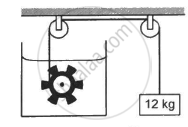
Figure shows a paddle wheel coupled to a mass of 12 kg through fixed frictionless pulleys. The paddle is immersed in a liquid of heat capacity 4200 J K−1 kept in an adiabatic container. Consider a time interval in which the 12 kg block falls slowly through 70 cm. (a) How much heat is given to the liquid? (b) How much work is done on the liquid? (c) Calculate the rise in the temperature of the liquid neglecting the heat capacity of the container and the paddle.
(b) 2000 J of heat energy is required to raise the temperature of 4 kg of a
metal by 3°c. Which expression gives the specific heat capacity of the metal?
Define heat capacity.
Write the approximate values of the specific latent heat of fusion of ice.
Write the approximate values of the specific latent heat of vaporization of steam.
Explain, why do sandy soils, get heated up quickly as compared to wet soils?
A certain amount of heat Q will warm 1 g of material X by 3°C and 1 g of material Y by 4°C. Which material has a higher specific heat capacity?
Why are athletes advised to put on extra clothes after competing on event?
The temperature of a lead piece of mass 400 g rises from 20°C to 50°C when 1560 J of heat is supplied to it. Calculate: Heat capacity of lead piece.
The temperature of a lead piece of mass 400 g rises from 20°C to 50°C when 1560 J of heat is supplied to it. Calculate Specific heat capacity of lead.
Calculate the amount of heat released when 5.0 g of water at 20°C is changed into ice at 0°C.
(Specific heat capacity of water = 4.2 J/g°C
Specific latent heat of fusion of ice = 336 J/g)
Write the name.
The amount of heat absorbed at constant temperature by unit mass of a liquid to convert into gaseous phase.
Numerical Problem.
What could be the final temperature of a mixture of 100 g of water at 90 °C and 600g of water at 20°C.
The molar specific heat of an ideal gas at constant pressure and constant volume is 'Cp' and 'Cv' respectively. If 'R' is the universal gas constant and the ratio 'Cp' to 'Cv' is 'γ' then CV = ______.
Match the following
| 1. | Specific heat capacity | a. | Dewar bottle |
| 2. | Calorimeter | b. | Lavoisier and Simon |
| 3. | Vacuum flask | c. | J Kg-1 K-1 |
| 4. | Ice – calorimeter | d. | Heat capacity |
Match the following:
| Column A | Column B | ||
| 1. | Specific heat capacity of water | a. | 0°C |
| 2. | Latent heat of fusion of ice | b. | 2260 J/g |
| 3. | Latent heat of vaporization of water | c. | 100°C |
| 4. | The melting point of iced | d. | 4.2 J/g°C |
| 5. | The boiling point of water | e. | 336 J/g |
Two blocks P and Q of different metals having their mass in the ratio 2 : 1 are given same amount of heat. Their temperature rises by same amount. Compare their specific heat capacities.
