Advertisements
Advertisements
Question
The difference between the two molar specific heats of gas is 9000 J/kg K. If the ratio of the two specific heats is 1.5, calculate the two molar specific heats.
Advertisements
Solution
Given,
Cp - Cv = 9000 J/kg K
`"C"_"p"/"C"_"v" = 1.5`
Cv = ?
Cp = ?
`"C"_"p"/"C"_"v" = 1.5`
`"C"_"p" = 1.5 " C"_"v"`
`"C"_"p" - "C"_"v" = 9000`
`1.5 " C"_"v" - "C"_"v" = 9000`
`0.5 " C"_"v" = 9000`
`therefore "C"_"v" = 9000/0.5`
= 18000 J/kg k
`therefore "C"_"p" = 9000 + "C"_"v"`
= 9000 + 18000
= 27000 J/kg k
∴ Two molar specific heats ore 18000 J/kg k and 27000 J/kg k.
APPEARS IN
RELATED QUESTIONS
It is generally cold after a hail-storm then during and before the hail storm. Give reason.
Name three fossil fuels that emit carbon dioxide into the atmosphere ?
State the impact of global warming on life on the earth.
How will rise in sea level affect population in coastal countries?
The global warming has resulted:
(a) the increase in yield of crops
(b) the decrease in sea levels
(c) the decrease in human deaths
(d) the increase in sea levels
A calorimeter has mass 100 g and specific heat 0.1 kcal/ kg°C. It contains 250 gm of liquid at 30°C having specific heat of 0.4 kcal/kg°C. If we drop a piece of ice of mass 10 g at 0°C, What will be the temperature of the mixture?
What is the specific heat capacity of boiling water?
A liquid X has specific heat capacity higher than the liquid Y. Which liquid is useful as coolant in car radiators.
Water boils at 120 °C in a pressure cooker. Explain the reason.
Explain, why temperature in hot summer, falls sharply after a sharp shower?
Explain, why do sandy soils, get heated up quickly as compared to wet soils?
Specific heat capacity of substance A is 3.8 J g-1 K-1whereas the specific heat capacity of substance B is 0.4 J g-1 K-1. Which of the two is a good conductor of heat? How is one led to this conclusion?
Ice-cream at 0°C feels colder than water at 0°C. Give reason for this observation.
A substance is in the form of a solid at 0°C. The amount of heat added to this substance and the temperature of the substance are plotted on the following graph:
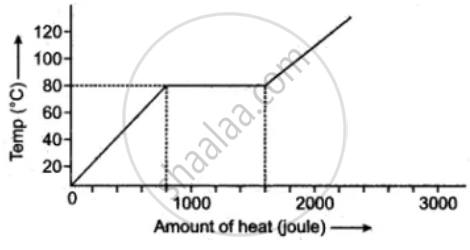
If the specific heat capacity of the solid substance is 500 J/kg °G, find from the graph, the mass of the substance.
A. hot solid of mass 60 g at 100°C is placed in 150 g of water at 20° C. The final steady temperature recorded is 25°C. Calculate the specific heat capacity of the solid. [Specific heat capacity of water = 4200 J kg-1 °C-1]
A vessel of negligible heat*capacity contains 40g of ice in it at 0°C, 8g of steam at 100°C is passed into the ice to melt it. Find the final temperature of the contents of the vessel.
(Specific latent heat of vaporization of steam = 2268 J/g, specific latent heat of fusion of ice = 336 J/f and specific heat capacity of water = 4.2 J/g°C)
Answer the following question.
Why do we generally consider two specific heats of a gas?
Read this activity and answer the following questions.
- Take three spheres of iron, copper and lead. the lead of equal mass.
- Put all the three spheres in boiling water in the beaker for some time.
- Take the three spheres out of the water.
- All the spheres will be at a temperature 100 °C.
- Put them immediately on the thick slab of wax.
- Note, the depth that each of the sphere goes into the wax.
Questions:
- Which property is determined from this activity?
- Give name to that property.
- Explain the term principal of heat exchange with the help of this activity.
Which of the substances P, Q, or R has the lowest specific heat? The temperature v/s time graph is shown ______.

The molar specific heats of an ideal gas at constant pressure and constant volume are denoted by Cp and Cv respectively. If `gamma = "C"_"p"/"C"_"v"` and R is the universal gas constant, then Cp is equal to ______.
The diagram below shows a cooling curve for 200 g of water. The heat is extracted at the rate of 100 Js-1. Answer the questions that follow:
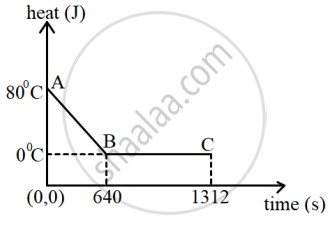
- Calculate specific heat capacity of water.
- Heat released in the region BC.
Two metals A and B have specific heat capacities in the ratio 2:3. If they are supplied same amount of heat then
If the mass ratio of metal A and metal B is 3:5 then calculate the ratio in which their temperatures rise.
Conductors have generally high specific heat capacities and insulators have low specific heat capacities.
Specific heat capacity of a substance X is 1900 Jkg-1°C-1 means ______.
Calculate the amount of heat energy required to raise the temperature of 200 g of copper from 20°C to 70°C. Specific heat capacity of copper = 390 J kg-1 K-1.
