Advertisements
Advertisements
Question
m kg of a substance of specific heat capacity s J/kg °C is heated so that its temperature rises from θ1°C to θ2°C. Write down the expression for the heat Q supplied.
Advertisements
Solution
Heat supplied Q = mass × sp. heat capacity × rise in temperature
= m × s × (θ2 – θ1)
RELATED QUESTIONS
Name three fossil fuels that emit carbon dioxide into the atmosphere ?
State three ways to minimize the global warming.
Who shall pay carbon tax ?
Specific heat capacity of a substance A is 3.8 J g-1 K-1 and of substance B is 0.4 J g-1 k-1. Which substance is a good conductor of heat? How did you arrive at your conclusion?
Explain, why water is considered as best liquid for quenching thirst?
A certain amount of heat Q will warm 1 g of material X by 3°C and 1 g of material Y by 4°C. Which material has a higher specific heat capacity?
A substance is in the form of a solid at 0°C. The amount of heat added to this substance and the temperature of the substance are plotted on the following graph:
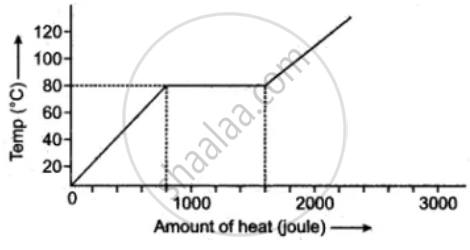
If the specific heat capacity of the solid substance is 500 J/kg °G, find from the graph, the mass of the substance.
Write the name.
The amount of heat absorbed at constant temperature by unit mass of a liquid to convert into gaseous phase.
Specific heat capacity C = ______.
What is the amount of heat required to raise the temperature of 5 kg of iron from 30°C to 130°C? Specific heat capacity of iron = 483 Jkg-1C-1.
