Advertisements
Advertisements
प्रश्न
m kg of a substance of specific heat capacity s J/kg °C is heated so that its temperature rises from θ1°C to θ2°C. Write down the expression for the heat Q supplied.
Advertisements
उत्तर
Heat supplied Q = mass × sp. heat capacity × rise in temperature
= m × s × (θ2 – θ1)
संबंधित प्रश्न
The coolant in a chemical or a nuclear plant (i.e., the liquid used to prevent the different parts of a plant from getting too hot) should have high specific heat.
Explain the term boiling ?
Name the radiations for which the green house gases are opaque ?
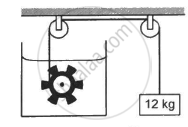
Figure shows a paddle wheel coupled to a mass of 12 kg through fixed frictionless pulleys. The paddle is immersed in a liquid of heat capacity 4200 J K−1 kept in an adiabatic container. Consider a time interval in which the 12 kg block falls slowly through 70 cm. (a) How much heat is given to the liquid? (b) How much work is done on the liquid? (c) Calculate the rise in the temperature of the liquid neglecting the heat capacity of the container and the paddle.
When a uniform rod is heated, which of the following quantity of the rod will increase
The value of 'γ' for a gas is given as `gamma = 1 + 2/"f"`, where 'f ' is the number of degrees of freedom of freedom of a molecule of a gas. What is the ratio of `gamma_"monoatonic"//gamma_"diatomic"`?
Diatomic gas consists of rigid gas molecules
A metal ball of heat capacity 50J/°C loses 2000 J of heat. By how much will its temperature fall?
When two kilocalories of heat are supplied to a system, the internal energy of the system increases by 5030 J and the work done by the gas against the external pressure is 3350 J. Calculate J, the mechanical equivalent of heat.
