Advertisements
Advertisements
प्रश्न
Advertisements
उत्तर
APPEARS IN
संबंधित प्रश्न
Give a mathematical relation between Heat Capacity and Specific Heat Capacity.
Discuss the role of high specific heat capacity of water with reference to climate in coastal areas.
Give one example where high specific heat capacity of water is used as heat reservoir ?
The ratio of specific heat capacity to molar heat capacity of a body _____________ .
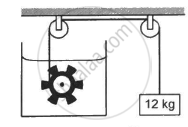
Figure shows a paddle wheel coupled to a mass of 12 kg through fixed frictionless pulleys. The paddle is immersed in a liquid of heat capacity 4200 J K−1 kept in an adiabatic container. Consider a time interval in which the 12 kg block falls slowly through 70 cm. (a) How much heat is given to the liquid? (b) How much work is done on the liquid? (c) Calculate the rise in the temperature of the liquid neglecting the heat capacity of the container and the paddle.
The product of mass and specific heat is known as ..........
Define heat capacity.
Explain, Why is it advisabile to pour cold water over burns, caused on human body, by hot solids?
From the options given below the specific heat of _______ is maximum.
If 'f' is the number of degrees of freedom of a molecule of a gas and ratio of molar specific heats of a gas, ϒ = 1 + `2/"f"` where ϒ = Cp/Cv. The ratio of 'ϒ' for monoatomic gas to 'ϒ' for (rigid) f diatomic gas is ______.
