Advertisements
Advertisements
प्रश्न
Find the odd one out:
पर्याय
Conduction
Convection
Radiation
Expansion
Advertisements
उत्तर
Expansion
Explanation:
Conduction, convection, and radiation are all ways of heat transport, whereas material expansion is a property.
APPEARS IN
संबंधित प्रश्न
A child running a temperature of 101°F is given an antipyrin (i.e. a medicine that lowers fever) which causes an increase in the rate of evaporation of sweat from his body. If the fever is brought down to 98 °F in 20 min, what is the average rate of extra evaporation caused, by the drug? Assume the evaporation mechanism to be the only way by which heat is lost. The mass of the child is 30 kg. The specific heat of human body is approximately the same as that of water, and latent heat of evaporation of water at that temperature is about 580 cal g–1.
During the phase change does the average kinetic energy of the molecules of the substance increase?
The temperature of 170 g of water at 50°C is lowered to 5°C by adding a certain amount of ice to it. Find the mass of ice added.
Given: Specific heat capacity of water = 4200 J kg-1 °C-1 and specific latent heat of ice = 336000 J kg-1.
What do you mean by the following statement?
The heat capacity of a body is 50 JK-1?
Water is used in hot water bottles for fomentation. Give a reason.
Name the radiations for which the green house gases are opaque ?
How does green house effect help in keeping the temperature of earth’s surface suitable for living of human beings?
State the effect of enhancement of green house effect.
How will climate changes affect the various animal species?
What is meant by specific heat capacity?
Read the following paragraph and answer the questions.
|
If heat is exchanged between a hot and cold object, the temperature of the cold object goes on increasing due to gain of energy and the temperature of the hot object goes on decreasing due to loss of energy. The change in temperature continues till the temperatures of both the objects attain the same value. In this process, the cold object gains heat energy and the hot object loses heat energy. If the system of both the objects is isolated from the environment by keeping it inside a heat resistant box (meaning that the energy exchange takes place between the two objects only), then no energy can flow from inside the box or come into the box. |
- Heat is transferred from where to where?
- Which principle do we learn about from this process?
- How will you state the principle briefly?
- Which property of the substance is measured using this principle?
A liquid X has specific heat capacity higher than the liquid Y. Which liquid is useful as heat reservoir to keep juice bottles without freezing?
Write two advantages of high specific heat capacity of water.
Write the approximate values of the specific latent heat of vaporization of steam.
Explain, why water is considered as best liquid for quenching thirst?
A piece of ice is heated at a constant rate. The variation of temperature with heat input is shown in the graph below:

(i) What are represented by AB and CD?
(ii) What conclusion can you draw regarding the 110°c nature of ice from the above graph?
Derive Mayer’s relation.
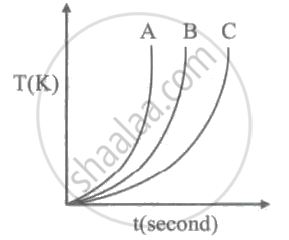
Which of the following substances (A, B and C) has the highest specific beat?
Two uniform brass rods A and B of length land 2l and radii 2r and r respectively are heated to the same temperature. The ratio of the increase in the volume ofB to that of A is ____________.
Water has the lowest specific heat capacity.
