Advertisements
Advertisements
प्रश्न
A substance is in the form of a solid at 0°C. The amount of heat added to this substance and the temperature of the substance are plotted on the following graph:
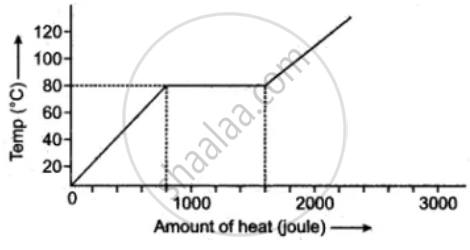
If the specific heat capacity of the solid substance is 500 J/kg °G, find from the graph, the mass of the substance.
Advertisements
उत्तर
From graph heat supplied is 800 joule during change in temperature from 0 to 80°C.
Heat = Mass × Sp. heat capacity × Rise in temperature
800 = m × 500 × 80
m = `1/50` kg
m = 20 g
संबंधित प्रश्न
In an experiment on the specific heat of a metal, a 0.20 kg block of the metal at 150 °C is dropped in a copper calorimeter (of water equivalent 0.025 kg) containing 150 cm3 of water at 27 °C. The final temperature is 40 °C. Compute the specific heat of the metal. If heat losses to the surroundings are not negligible, is your answer greater or smaller than the actual value for the specific heat of the metal?
Write the approximate value of specific heat capacity of water in S.I. unit.
How will you prove experimentally that different substances have different specific heat capacities?
(i) State whether the specific heat capacity of a substance remains the same when its state changes from solid to liquid.
(ii) Give one example to support your answer.
Give one example where high specific heat capacity of water is used as cooling.
63.2 g of copper at 50°C can just melt 3.8g of ice. If the specific latent heat of ice is 336 J/g, find the specific heat capacity of copper.
Derive Mayer’s relation.
What is the amount of heat required to raise the temperature of 5 kg of iron from 30°C to 130°C? Specific heat capacity of iron = 483 Jkg-1C-1.
To study energy exchange between hot and cold objects, the system of both objects is isolated from the environment by keeping them inside ______.
