Advertisements
Advertisements
Question
A substance is in the form of a solid at 0°C. The amount of heat added to this substance and the temperature of the substance are plotted on the following graph:
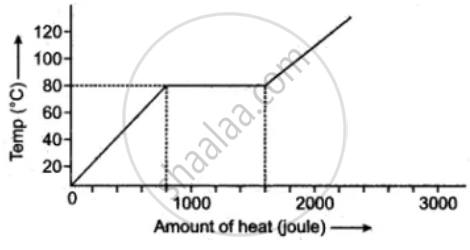
If the specific heat capacity of the solid substance is 500 J/kg °G, find from the graph, the mass of the substance.
Advertisements
Solution
From graph heat supplied is 800 joule during change in temperature from 0 to 80°C.
Heat = Mass × Sp. heat capacity × Rise in temperature
800 = m × 500 × 80
m = `1/50` kg
m = 20 g
RELATED QUESTIONS
A solid of mass 50 g at 150 °C is placed in 100 g of water at 11 °C when the final temperature recorded is 20 °C. Find the specific heat capacity of the solid. (specific heat capacity of water = 4.2 J/g °C)
State two factors upon which the heat absorbed by a body depends
Heat energy is supplied at a constant rate to 100g of ice at 0 °C. The ice is converted into water at 0° C in 2 minutes. How much time will be required to raise the temperature of water from 0 °C to 20 °C? [Given: sp. heat capacity of water = 4.2 J g-1 °C-1, sp. latent heat of ice = 336 J g-1].
A vessel of negligible heat*capacity contains 40g of ice in it at 0°C, 8g of steam at 100°C is passed into the ice to melt it. Find the final temperature of the contents of the vessel.
(Specific latent heat of vaporization of steam = 2268 J/g, specific latent heat of fusion of ice = 336 J/f and specific heat capacity of water = 4.2 J/g°C)
Numerical Problem.
What could be the final temperature of a mixture of 100 g of water at 90 °C and 600g of water at 20°C.
A piece of lead weighing 500 g gives out 1200 calories of heat when it is cooled from 100° C to 20° C. Find its specific heat.
Calculate the amount of heat energy required to raise the temperature of 200 g of copper from 20°C to 70°C. Specific heat capacity of copper = 390 J kg-1 K-1.
A mixture of one mole of monoatomic gas and one mole of a diatomic gas (rigid) are kept at room temperature (27°C). The ratio of specific heat of gases at constant volume respectively is:
