Advertisements
Advertisements
Question
The ratio of specific heat capacity to molar heat capacity of a body _____________ .
Options
is a universal constant
depends on the mass of the body
depends of the molecular weight of the body
is dimensionless
Advertisements
Solution
depends of the molecular weight of the body
Specific heat capacity of a body,
\[s = \frac{Q}{m\Delta\theta}\]
Here,
Q = Heat supplied
m = Mass of body
Δθ = Change in temperature
Molar heat capacity of a body,
\[C = \frac{Q}{n\Delta\theta}\]
Here,
Q = Heat supplied
n = Number of moles
Δθ = Change in temperature
∴ The ratio of the specific heat capacity and molar heat capacity is given by
\[\frac{s}{C} = \frac{\frac{Q}{m\Delta\theta}}{\frac{Q}{n\Delta\theta}} = \frac{n}{m} = \frac{n}{nM} = \frac{1}{M}\]
Here,
M = Molar mass related to number of moles
m = Mass
As the value of M is different for different bodies of different composition, the ratio cannot be a universal constant.
Also, the ratio is independent of the mass of the body.
The ratio of the specific heat and molar heat capacity depends on the molecular weight of the body.
Clearly, the unit of molecular weight is kg/mole. So, the ratio that depends only on the molecular weight cannot be dimensionless.
APPEARS IN
RELATED QUESTIONS
What property of water makes it an effective coolant?
Specific heat capacity of substance A is 3.8 J g-1K-1 whereas the specific heat capacity of substance B is 0.4 J g-1 K-1
(i) Which of the two is a good conductor of heat?
(ii) How is one led to the above conclusion?
(iii) If substances A and B are liquids then which one would be more useful in car radiators?
Heat supplied to a solid change it into liquid. What is this change in the phase called?
Name the S.I. unit of heat.
Two metallic blocks P and Q of masses in ratio 2: 1 are given the same amount of heat. If their temperature rise by the same amount, compare their specific heat capacities.
A heater of power P watt raises the temperature of m kg of a liquid by Δt K in time t s. Express
the specific heat capacity of liquid in terms of above data.
How does green house effect help in keeping the temperature of earth’s surface suitable for living of human beings?
Give three reasons for the increase of green house gases.
What is meant by global warming?
Study the following procedure and answer the questions below:
1. Take 3 spheres of iron, copper and lead of equal mass.
2. Put all the 3 spheres in boiling water in a beaker for some time.
3. Take 3 spheres out of the water. Put them immediately on a thick slab of wax.
4. Note, the depth that each sphere goes into the wax.
i) Which property of substance can be studied with this procedure?
ii) Describe that property in minimum words.
iii) Explain the rule of heat exchange with this property.
Indian style of cooling drinking water is to keep it in a pitcher having porous walls. Water comes to the outer surface very slowly and evaporates. Most of energy needed for evaporation is taken from the water itself and the water is cooled down. Assume that a pitcher contains 10 kg of water and 0.2 g of water comes out per second. Assuming no backward heat transfer from the atmosphere to the water, calculate the time in which the temperature decrease by 5°C. Specific heat capacity of water = 4200 J kg−1 °C−1 and latent heat of vaporization of water = 2.27 × 10⁶ J kg−1.
(i) State whether the specific heat capacity of a substance remains the same when its state changes from solid to liquid.
(ii) Give one example to support your answer.
104g of water at 30°C is taken in a calorimeter made of copper of mass 42 g. When a certain mass of ice at 0°C is added to it, the final steady temperature of the mixture after the ice has melted, was found to be 10°C. Find the mass of ice added. [Specific heat capacity of water = 4.2 Jg–1°C–1 ; Specific latent heat of fusion of ice = 336 Jg–1; Specific heat capacity of copper = 0.4 Jg–1°C–1] .
Define the term 'specific heat capacity' and state its unit.
650 J of heat is required to raise the temp. of 0.25 kg of lead from 15°C to 35°C. Calculate the Sp. heat capacity of lead.
State, with reason, which of the two, boiling water or steam both at 100°C will produce more severe burns.
A liquid X has specific heat capacity higher than the liquid Y. Which liquid is useful as coolant in car radiators.
Explain, Why is it advisabile to pour cold water over burns, caused on human body, by hot solids?
A certain amount of heat Q will warm 1 g of material X by 3°C and 1 g of material Y by 4°C. Which material has a higher specific heat capacity?
An equal quantity of heat is supplied to two substances A and B. The substance A shows a greater rise in temperature. What can you say about the heat capacity of A as compared to that of B?
Will the value of specific heat’capacity and specific latent heat of a substance change if the scale is °F instead of °C?
Water falls from a height of 50 m. Calculate the rise in the temperature of water when it strikes the bottom.
(g = 10 ms-2; Specific heat capacity of water = 4200 J / kg°C)
An electric immersion heater is rated 1250 W. Calculate the time in which it will heat 20 kg of water at 5°C to 65°C.
Answer the following question.
Why do we generally consider two specific heats of a gas?
State factors on which the amount of heat radiated by a body depends.
Write the name.
The amount of heat absorbed at constant temperature by unit mass of a liquid to convert into gaseous phase.
The specific heat capacity of water is 1 cal/g °C.
Explain how heat capacity of a solid can be determined by the method of mixture.
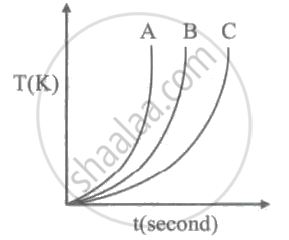
Which of the following substances (A, B and C) has the highest specific beat?
An office room contains about 4000 moles of air. The change in the internal energy of this much air when it is cooled from 34° C to 19° C at a constant pressure of 1.0 atm is (Use `gamma_"air"` = 1.4 and Universal gas constant = 8.314 J / mol K) ____________.
Two metals A and B have specific heat capacities in the ratio 2 : 3. If they are supplied the same amount of heat then
Which metal piece will show a greater rise in temperature given their masses is the same?
The specific heat capacity of water is ______.
Thermal capacities of substances A and B are same. If mass of A is more than mass of B then:
Which substance will have more specific heat capacity?
In the method of mixtures, a hot metal is dropped into cold water and the mixture reaches a final temperature. Which principle is used to find the specific heat of the metal?
