Advertisements
Advertisements
Question
Match the columns:
| Column ‘A’ | Column ‘B’ |
| The SI unit of specific heat capacity | (a) Jkg−1°C−1 |
| (b) kg/m3 | |
| (c) calorie |
Advertisements
Solution
| Column ‘A’ | Column ‘B’ |
| The SI unit of specific heat capacity | (a) Jkg−1°C−1 |
APPEARS IN
RELATED QUESTIONS
In an experiment on the specific heat of a metal, a 0.20 kg block of the metal at 150 °C is dropped in a copper calorimeter (of water equivalent 0.025 kg) containing 150 cm3 of water at 27 °C. The final temperature is 40 °C. Compute the specific heat of the metal. If heat losses to the surroundings are not negligible, is your answer greater or smaller than the actual value for the specific heat of the metal?
Water in lakes and ponds do not freeze at once in cold countries. Give a reason is support of your answer.
A liquid X has the maximum specific heat capacity and is used as a coolant in Car Radiators. Name the liquid X.
Give a mathematical relation between Heat Capacity and Specific Heat Capacity.
The temperature of 170 g of water at 50°C is lowered to 5°C by adding a certain amount of ice to it. Find the mass of ice added.
Given: Specific heat capacity of water = 4200 J kg-1 °C-1 and specific latent heat of ice = 336000 J kg-1.
How much heat energy is released when 5.0 g of water at 20℃ changes into ice at 0℃? Take specific heat capacity of water = 4.2 J g-1 K-1, Specific latent heat of fusion of ice = 336 J g-1.
How will climate changes affect the various animal species?
What impact will climate changes have on the crops of food?
What is the specific heat capacity of melting ice?
Explain, why temperature in hot summer, falls sharply after a sharp shower?
Explain, why do sandy soils, get heated up quickly as compared to wet soils?
If substances A and B are liquids then which one would be more useful in car radiators?
Given: Specific heat capacity’A’ 3.8 J/g /K. Specific heat capacity ‘B’ 0.4 J/g /K.
A substance is in the form of a solid at 0°C. The amount of heat added to this substance and the temperature of the substance are plotted on the following graph:
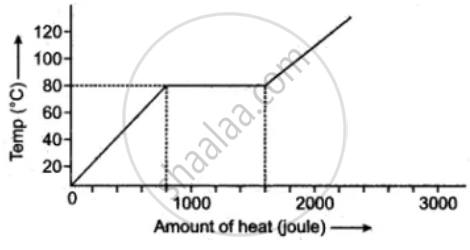
If the specific heat capacity of the solid substance is 500 J/kg °G, find from the graph, the mass of the substance.
What is specific heat capacity?
50 g of copper is heated to increase its temperature by 10° C. If the same quantity of heat is given to 5 g water, the rise in its temperature is [Specific heat of copper = 420 joule-kg-1 °C-1 , specific heat of water = 4200 joule-kg-I °C-1]
Two uniform brass rods A and B of length land 2l and radii 2r and r respectively are heated to the same temperature. The ratio of the increase in the volume ofB to that of A is ____________.
The difference between the two molar specific heats of gas is 9000 J/kg K. If the ratio of the two specific heats is 1.5, calculate the two molar specific heats.
