Advertisements
Advertisements
Question
The molar specific heat of a gas at constant volume is 12307.69 J kg-1 K-1. If the ratio of the two specific heats is 1.65, calculate the difference between the two molar specific heats of gas.
Options
7999 J kg-1 K-1
7245 J kg-1 K-1
6890 J kg-1 K-1
4067 J kg-1 K-1
Advertisements
Solution
7999 J kg-1 K-1
APPEARS IN
RELATED QUESTIONS
50 g of metal piece at 27°C requires 2400 J of heat energy so as to attain a temperature of 327°C . Calculate the specific heat capacity of the metal.
A liquid X has the maximum specific heat capacity and is used as a coolant in Car Radiators. Name the liquid X.
Give a mathematical relation between Heat Capacity and Specific Heat Capacity.
Write the expression for the heat energy Q received by the substance when m kg of substance of specific heat capacity c Jkg-1 k-1 is heated through Δt° C.
Two metallic blocks P and Q of masses in ratio 2: 1 are given the same amount of heat. If their temperature rise by the same amount, compare their specific heat capacities.
Describe a method to determine the specific heat capacity of a solid, like a piece of copper ?
A heater of power P watt raises the temperature of m kg of a liquid by Δt K in time t s. Express
the specific heat capacity of liquid in terms of above data.
The specific heat capacity of water is :
Explain the term boiling ?
State the effect of enhancement of green house effect.
State three ways to minimize the global warming.
Name and state the principle used to measure the specific heat capacity of a substance.
The ratio of specific heat capacity to molar heat capacity of a body _____________ .
Give one example where high specific heat capacity of water is used as cooling.
Specific heat capacity of a substance A is 3.8 J g-1 K-1 and of substance B is 0.4 J g-1 k-1. Which substance is a good conductor of heat? How did you arrive at your conclusion?
Explain, why water is considered as best liquid for quenching thirst?
Explain, why does a wise farmer water his fields, if forecast is forst?
Discuss how high specific heat capacity of water helps in formation of land and sea breeze.
Derive an expression for finding out the specific heat capacity of a body (solid) from the readings of an experiment given below:
(i) Mass of empty calorimeter (with stirrer) = m1 gm
(ii) Mass of the metal piece = M gm
(iii) Mass of colorimeter and water = m2 gm
(iv) Initial temperature and water = t1°C
(v) Temperature of hot solid (metal piece) = t2 °C
(vi) Final temperature of the mixture = t°C
(vii) Specific heat of calorimeter = 0.4 J gm / °C
Explain how heat capacity of a solid can be determined by the method of mixture.
Read this activity and answer the following questions.
- Take three spheres of iron, copper and lead. the lead of equal mass.
- Put all the three spheres in boiling water in the beaker for some time.
- Take the three spheres out of the water.
- All the spheres will be at a temperature 100 °C.
- Put them immediately on the thick slab of wax.
- Note, the depth that each of the sphere goes into the wax.
Questions:
- Which property is determined from this activity?
- Give name to that property.
- Explain the term principal of heat exchange with the help of this activity.
_______ is defined as the amount of heat required to raise the temperature of 1kg of a substance by 1°C.
An office room contains about 4000 moles of air. The change in the internal energy of this much air when it is cooled from 34° C to 19° C at a constant pressure of 1.0 atm is (Use `gamma_"air"` = 1.4 and Universal gas constant = 8.314 J / mol K) ____________.
The diagram below shows a cooling curve for 200 g of water. The heat is extracted at the rate of 100 Js-1. Answer the questions that follow:
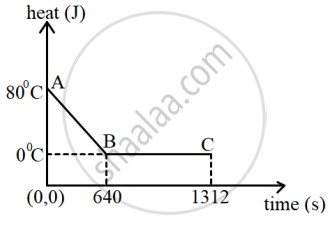
- Calculate specific heat capacity of water.
- Heat released in the region BC.
Match the following:
| Column A | Column B | ||
| 1. | Specific heat capacity of water | a. | 0°C |
| 2. | Latent heat of fusion of ice | b. | 2260 J/g |
| 3. | Latent heat of vaporization of water | c. | 100°C |
| 4. | The melting point of iced | d. | 4.2 J/g°C |
| 5. | The boiling point of water | e. | 336 J/g |
A block of ice of mass 120 g at temperature 0°C is put in 300 gm of water at 25°C. The xg of ice melts as the temperature of the water reaches 0°C. The value of x is ______.
[Use: Specific heat capacity of water = 4200 Jkg-1K-1, Latent heat of ice = 3.5 × 10⁵ Jkg-1]
