Advertisements
Advertisements
Question
Solve the following problems:
Equal heat is given to two objects A and B of mass 1 g. Temperature of A increases by 3°C and B by 5°C. Which object has more specific heat? And by what factor?
Advertisements
Solution
\[s = \frac{∆ Q}{m ∆ T}\]
Let Q cal of heat is given to both A and B.
For body A,
\[s_1 = \frac{Q}{1 \times 3} = \frac{Q}{3} \text {cal }g^{- 1} {}^o C^{- 1}\]
For body B,
\[s_2 = \frac{Q}{1 \times 5} = \frac{Q}{5} \text { cal } g^{- 1} {}^o C^{- 1}\]
Now,
\[\frac{s_1}{s_2} = \frac{\frac{Q}{3}}{\frac{Q}{5}} = \frac{5}{3}\]
\[ \Rightarrow s_1 = \frac{5}{3} s_2\]
Thus, specific heat capacity of body A is more than body B and by a factor of \[\frac{5}{3}\].
APPEARS IN
RELATED QUESTIONS
A child running a temperature of 101°F is given an antipyrin (i.e. a medicine that lowers fever) which causes an increase in the rate of evaporation of sweat from his body. If the fever is brought down to 98 °F in 20 min, what is the average rate of extra evaporation caused, by the drug? Assume the evaporation mechanism to be the only way by which heat is lost. The mass of the child is 30 kg. The specific heat of human body is approximately the same as that of water, and latent heat of evaporation of water at that temperature is about 580 cal g–1.
A geyser heats water flowing at the rate of 3.0 litres per minute from 27 °C to 77 °C. If the geyser operates on a gas burner, what is the rate of consumption of the fuel if its heat of combustion is 4.0 × 10⁴ J/g?
Give a mathematical relation between Heat Capacity and Specific Heat Capacity.
Water is used in hot water bottles for fomentation. Give a reason.
45 g of water at 50°C in a beaker is cooled when 50 g of copper at 18° C is added to it. The contents are stirred till a final constant temperature is reached. Calculate this final temperature. The specific heat capacity of copper is 0.39 J g-1K-1 and that of water is 4.2 J g-1K-1. State the assumption used.
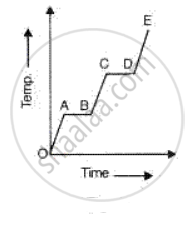
A substance is heated at a constant rate from a low temperature to a high temperature. A graph of temperature against time is shown in the figure. Which part or parts of the graph correspond(s) to the substance existing in two states?
What change in heat energy occurs when lead at its melting point
solidifies without change in the temperature?
A burner raises the temperature of 360 g of water from 40°C to 100°C in 5 minutes. Calculate the rate of heat supplied by the burner.
650 J of heat is required to raise the temp. of 0.25 kg of lead from 15°C to 35°C. Calculate the Sp. heat capacity of lead.
m kg of a substance of specific heat capacity s J/kg °C is heated so that its temperature rises from θ1°C to θ2°C. Write down the expression for the heat Q supplied.
The farmers fill their fields with water in winter. Give reason.
Explain, Why is it advisabile to pour cold water over burns, caused on human body, by hot solids?
Ice-cream at 0°C feels colder than water at 0°C. Give reason for this observation.
The molar specific heat of a gas at constant volume is 12307.69 J kg-1 K-1. If the ratio of the two specific heats is 1.65, calculate the difference between the two molar specific heats of gas.
Write a short note.
Specific heat capacity
Explain why the specific heat capacity at constant pressure is greater than the specific heat capacity at constant volume.
The ratio of the specific heats `c_"p"/c_"v"=gamma` in terms of degrees of freedom 'n' is given by ______.
Thermal capacities of substances A and B are same. If mass of A is more than mass of B then:
Which substance will have more specific heat capacity?
In the method of mixtures, a hot metal is dropped into cold water and the mixture reaches a final temperature. Which principle is used to find the specific heat of the metal?
