Advertisements
Advertisements
Question
The coolant in a chemical or a nuclear plant (i.e., the liquid used to prevent the different parts of a plant from getting too hot) should have high specific heat.
Advertisements
Solution 1
The coolant in a chemical or nuclear plant should have a high specific heat. This is because higher the specific heat of the coolant, higher is its heat-absorbing capacity and vice versa. Hence, a liquid having a high specific heat is the best coolant to be used in a nuclear or chemical plant. This would prevent different parts of the plant from getting too hot
Solution 2
This is because heat absorbed by a substance is directly proportional to the specific heat of the substance.
APPEARS IN
RELATED QUESTIONS
A solid of mass 50 g at 150 °C is placed in 100 g of water at 11 °C when the final temperature recorded is 20 °C. Find the specific heat capacity of the solid. (specific heat capacity of water = 4.2 J/g °C)
State two factors upon which the heat absorbed by a body depends
Specific heat capacity of substance A is 3.8 J g-1K-1 whereas the specific heat capacity of substance B is 0.4 J g-1 K-1
(i) Which of the two is a good conductor of heat?
(ii) How is one led to the above conclusion?
(iii) If substances A and B are liquids then which one would be more useful in car radiators?
During the phase change does the average kinetic energy of the molecules of the substance increase?
Differentiate between heat capacity and specific heat capacity.
Write the approximate value of specific heat capacity of water in S.I. unit.
What do you mean by the following statement?
The specific heat capacity of copper is 0. 4 Jg-1 K-1?
Water property of water makes it an effective coolant?
Give one example where high specific heat capacity of water is used as heat reservoir ?
A heater of power P watt raises the temperature of m kg of a liquid by Δt K in time t s. Express
the specific heat capacity of liquid in terms of above data.
Explain the term boiling point ?
Name the radiations for which the green house gases are opaque ?
Give three reasons for the increase of green house gases.
Who shall pay carbon tax ?
What is meant by specific heat capacity?
A calorimeter has mass 100 g and specific heat 0.1 kcal/ kg°C. It contains 250 gm of liquid at 30°C having specific heat of 0.4 kcal/kg°C. If we drop a piece of ice of mass 10 g at 0°C, What will be the temperature of the mixture?
In Regnault's apparatus for measuring specific heat capacity of a solid, there is an inlet and an outlet in the steam chamber. The inlet is near the top and the outlet is near the bottom. Why is it better than the opposite choice where the inlet is near the bottom and the outlet is near the top?
If 10125 J of heat energy boils off 4.5 g of water at 100°C to steam at 100°C, find the specific latent heat of steam.
A liquid X has specific heat capacity higher than the liquid Y. Which liquid is useful as heat reservoir to keep juice bottles without freezing?
Write the approximate values of the specific latent heat of vaporization of steam.
Explain, why do sandy soils, get heated up quickly as compared to wet soils?
If substances A and B are liquids then which one would be more useful in car radiators?
Given: Specific heat capacity’A’ 3.8 J/g /K. Specific heat capacity ‘B’ 0.4 J/g /K.
A certain amount of heat Q will warm 1 g of material X by 3°C and 1 g of material Y by 4°C. Which material has a higher specific heat capacity?
An equal quantity of heat is supplied to two substances A and B. The substance A shows a greater rise in temperature. What can you say about the heat capacity of A as compared to that of B?
If, in a central heating system, steam enters a radiation pipe at 100°C and water leaves the radiation pipe at 100°C, can this radiation pipe heat a room? Give an explanation for your answer.
The temperature of a lead piece of mass 400 g rises from 20°C to 50°C when 1560 J of heat is supplied to it. Calculate: Heat capacity of lead piece.
A. hot solid of mass 60 g at 100°C is placed in 150 g of water at 20° C. The final steady temperature recorded is 25°C. Calculate the specific heat capacity of the solid. [Specific heat capacity of water = 4200 J kg-1 °C-1]
Calculate the amount of heat released when 5.0 g of water at 20°C is changed into ice at 0°C.
(Specific heat capacity of water = 4.2 J/g°C
Specific latent heat of fusion of ice = 336 J/g)
All metals have the same specific heat capacity.
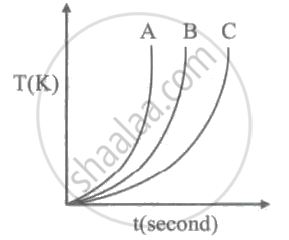
Which of the following substances (A, B and C) has the highest specific beat?
On supplying 100 µC of charge to a conductor, its potential rises by 5 V then capacity of the conductor is ______.
Find the odd one out:
Observe the following diagram and answer the questions given below:

Specific heat capacity of metals
- Which element has maximum specific heat capacity? Justify.
- Which element has minimum specific heat capacity? Justify.
- Define specific heat of object.
Specific heat capacity of a substance X is 1900 Jkg-1°C-1 means ______.
In the method of mixtures, a hot metal is dropped into cold water and the mixture reaches a final temperature. Which principle is used to find the specific heat of the metal?
