Advertisements
Advertisements
Question
The temperature of a lead piece of mass 400 g rises from 20°C to 50°C when 1560 J of heat is supplied to it. Calculate: Heat capacity of lead piece.
Advertisements
Solution
Heat capacity of lead piece
= `"Heat supplied"/"Rise in temperature" = (1560 "J")/(50 - 20^circ "C")` = 52 J/° C.
RELATED QUESTIONS
Given below are observations on molar specific heats at room temperature of some common gases.
| Gas |
Molar specific heat (Cv) (cal mol–1 K–1) |
| Hydrogen | 4.87 |
| Nitrogen | 4.97 |
| Oxygen | 5.02 |
| Nitric oxide | 4.99 |
| Carbon monoxide | 5.01 |
| Chlorine | 6.17 |
The measured molar specific heats of these gases are markedly different from those for monatomic gases. Typically, molar specific heat of a monatomic gas is 2.92 cal/mol K. Explain this difference. What can you infer from the somewhat larger (than the rest) value for chlorine?
A geyser heats water flowing at the rate of 3.0 litres per minute from 27 °C to 77 °C. If the geyser operates on a gas burner, what is the rate of consumption of the fuel if its heat of combustion is 4.0 × 10⁴ J/g?
Write the approximate value of specific heat capacity of water in S.I. unit.
Water property of water makes it an effective coolant?
Name and state the principle used to measure the specific heat capacity of a substance.
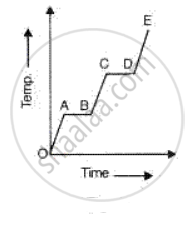
A substance is heated at a constant rate from a low temperature to a high temperature. A graph of temperature against time is shown in the figure. Which part or parts of the graph correspond(s) to the substance existing in two states?
How much heat energy is released when 5 g of water at 20° C changes to ice at 0° C?
[Specific heat capacity of water = 4.2 J g-1 ° C-1 Specific latent heat of fusion of ice = 336 J g-1]
If 'Cp' and 'Cv' are molar specific heats of an ideal gas at constant pressure and volume respectively. If 'λ' is the ratio of two specific heats and 'R' is universal gas constant then 'Cp' is equal to ______.
Calculate the amount of heat energy required to raise the temperature of 200 g of copper from 20°C to 70°C. Specific heat capacity of copper = 390 J kg-1 K-1.
