Advertisements
Advertisements
Question
What is the specific heat capacity of boiling water?
Advertisements
Solution
The specific heat capacity of boiling water is 0.46 cal/g-oC or 1926 J/kg-K.
APPEARS IN
RELATED QUESTIONS
What amount of heat must be supplied to 2.0 x 10⁻² kg of nitrogen (at room temperature) to raise its temperature by 45 °C at constant pressure? (Molecular mass of N2 = 28; R = 8.3 J mol-1 K-1.)
State two factors upon which the heat absorbed by a body depends
During the phase change does the average kinetic energy of the molecules of the substance increase?
Name the S.I. unit of heat.
Describe a method to determine the specific heat capacity of a solid, like a piece of copper ?
The S.I. unit of specific heat capacity is ______.
An electric heater of power 600 W raises the temperature of 4.0 kg of a liquid from 10.0℃ to 15.0℃ in100 s. Calculate:
- the heat capacity of 4.0 kg of liquid,
- the specific heat capacity of the liquid.
Explain the term boiling point ?
It is generally cold after a hail-storm then during and before the hail storm. Give reason.
State the effect of enhancement of green house effect.
How will global warming disturb the ecological balance?
How will you prove experimentally that different substances have different specific heat capacities?
Equal heat is given to two objects A and B of mass 1 g. Temperature of A increases by 3°C and B by 5°C. Which object has more specific heat? And by what factor?
State, with reason, which of the two, boiling water or steam both at 100°C will produce more severe burns.
A piece of iron of mass 2.0 kg has a heat capacity of 966 J K-1. Find its specific heat capacity in S.I unit.
What are the factors on which the quantity of heat given to a body depends?
Write the approximate values of the specific latent heat of vaporization of steam.
Explain, why water is considered as best liquid for quenching thirst?
Explain, Why is it advisabile to pour cold water over burns, caused on human body, by hot solids?
Is it possible to condense the water formed, back to ice by adding ice at 0°C. Explain with reason.
If, in a central heating system, steam enters a radiation pipe at 100°C and water leaves the radiation pipe at 100°C, can this radiation pipe heat a room? Give an explanation for your answer.
The temperature of a lead piece of mass 400 g rises from 20°C to 50°C when 1560 J of heat is supplied to it. Calculate: Heat capacity of lead piece.
Water falls from a height of 50 m. Calculate the rise in the temperature of water when it strikes the bottom.
(g = 10 ms-2; Specific heat capacity of water = 4200 J / kg°C)
Write the name.
The amount of heat absorbed at constant temperature by unit mass of a liquid to convert into gaseous phase.
Decide the unit for specific heat capacity.
The cold object the hot object enclosed in one box of heat-resistant material.
- What changes will occur in the two objects when temperature flows from those objects?
- Which principle can show that the energy exchange takes place between two objects only when kept in isolated system?
Read the passage and answer the questions based on it.
If heat is exchanged between a hot and cold object, the temperature of the cold object goes on increasing due to gain of energy and the temperature of the hot object goes on decreasing due to loss of energy. The change in temperature continues till the temperatures of both objects attain the same value. In this process, the cold object gains heat energy and the hot object loses heat energy. If the system of both the objects is isolated from the environment by keeping it inside a heat-resistant box then no energy can flow from inside the box or come into the box. In this situation, we get the following principle.
Heat energy lost by the hot object = Heat energy gained by the cold object. This is called the ‘Principle of heat exchange’.
- Where does heat transfer take place?
- In such a situation which principle of heat do you perceive?
- How can this principle be explained in short?
- Measuring the property of which substance this principle is used?
Express the change in internal energy in terms of molar specific heat capacity.
Derive Meyer’s relation for an ideal gas.
On supplying 100 µC of charge to a conductor, its potential rises by 5 V then capacity of the conductor is ______.
The ratio of the specific heats `c_"p"/c_"v"=gamma` in terms of degrees of freedom 'n' is given by ______.
The diagram below shows a cooling curve for 200 g of water. The heat is extracted at the rate of 100 Js-1. Answer the questions that follow:
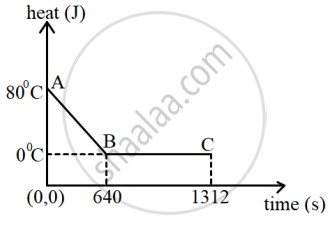
- Calculate specific heat capacity of water.
- Heat released in the region BC.
Water has the lowest specific heat capacity.
A block of ice of mass 120 g at temperature 0°C is put in 300 gm of water at 25°C. The xg of ice melts as the temperature of the water reaches 0°C. The value of x is ______.
[Use: Specific heat capacity of water = 4200 Jkg-1K-1, Latent heat of ice = 3.5 × 10⁵ Jkg-1]
Observe the following diagram and answer the questions given below:

Specific heat capacity of metals
- Which element has maximum specific heat capacity? Justify.
- Which element has minimum specific heat capacity? Justify.
- Define specific heat of object.
Calculate the amount of heat energy required to raise the temperature of 200 g of copper from 20°C to 70°C. Specific heat capacity of copper = 390 J kg-1 K-1.
A 0.2 kg metal at 150°C is placed in a copper calorimeter (water equivalent 0.025 kg) with 150 cm³ water at 27°C. Final temperature is 40°C. Find the specific heat of the metal.
