Advertisements
Advertisements
प्रश्न
What is the specific heat capacity of boiling water?
Advertisements
उत्तर
The specific heat capacity of boiling water is 0.46 cal/g-oC or 1926 J/kg-K.
APPEARS IN
संबंधित प्रश्न
What do you understand by the following statements:
The specific heat capacity of lead is 130 Jkg-1K-1.
What property of water makes it an effective coolant?
50 g of metal piece at 27°C requires 2400 J of heat energy so as to attain a temperature of 327°C . Calculate the specific heat capacity of the metal.
Heat energy is supplied at a constant rate to 100g of ice at 0 °C. The ice is converted into water at 0° C in 2 minutes. How much time will be required to raise the temperature of water from 0 °C to 20 °C? [Given: sp. heat capacity of water = 4.2 J g-1 °C-1, sp. latent heat of ice = 336 J g-1].
Why do the farmers fill their fields with water on a cold winter night?
Water is used in hot water bottles for fomentation. Give a reason.
Water property of water makes it an effective coolant?
Find the time taken by a 500 W heater to raise the temperature of 50 kg of material of specific heat capacity 960 J kg-1K-1, from 18°C to 38° C. Assume that all the heat energy supplied by the heater is given to the material.
Explain the term boiling ?
It is generally cold after a hail-storm then during and before the hail storm. Give reason.
Name two green house gases ?
How does green house effect help in keeping the temperature of earth’s surface suitable for living of human beings?
The global warming has resulted:
(a) the increase in yield of crops
(b) the decrease in sea levels
(c) the decrease in human deaths
(d) the increase in sea levels
What is meant by specific heat capacity?
A calorimeter has mass 100 g and specific heat 0.1 kcal/ kg°C. It contains 250 gm of liquid at 30°C having specific heat of 0.4 kcal/kg°C. If we drop a piece of ice of mass 10 g at 0°C, What will be the temperature of the mixture?
Study the following procedure and answer the questions below:
1. Take 3 spheres of iron, copper and lead of equal mass.
2. Put all the 3 spheres in boiling water in a beaker for some time.
3. Take 3 spheres out of the water. Put them immediately on a thick slab of wax.
4. Note, the depth that each sphere goes into the wax.
i) Which property of substance can be studied with this procedure?
ii) Describe that property in minimum words.
iii) Explain the rule of heat exchange with this property.
A burner raises the temperature of 360 g of water from 40°C to 100°C in 5 minutes. Calculate the rate of heat supplied by the burner.
A liquid X has specific heat capacity higher than the liquid Y. Which liquid is useful as coolant in car radiators.
Explain, Why is it advisabile to pour cold water over burns, caused on human body, by hot solids?
A substance is in the form of a solid at 0°C. The amount of heat added to this substance and the temperature of the substance are plotted on the following graph:
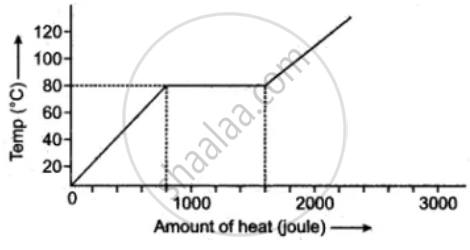
If the specific heat capacity of the solid substance is 500 J/kg °G, find from the graph, the mass of the substance.
The temperature of a lead piece of mass 400 g rises from 20°C to 50°C when 1560 J of heat is supplied to it. Calculate Specific heat capacity of lead.
Answer the following question.
Why do we generally consider two specific heats of a gas?
The molar specific heat of a gas at constant volume is 12307.69 J kg-1 K-1. If the ratio of the two specific heats is 1.65, calculate the difference between the two molar specific heats of gas.
How much heat energy is necessary to raise the temperature of 5 kg of water from 20°C to 100°C?
Numerical Problem.
What is the heat in joules required to raise the temperature of 25 grams of water from 0°C to 100°C? What is the heat in Calories? (Specific heat of water = `(4.18"J")/("g"°"C")`
The molar specific heats of an ideal gas at constant pressure and constant volume are denoted by Cp and Cv respectively. If `gamma = "C"_"p"/"C"_"v"` and R is the universal gas constant, then Cp is equal to ______.
At same temperature and pressure of an ideal gas, ____________.
A piece of lead weighing 500 g gives out 1200 calories of heat when it is cooled from 100° C to 20° C. Find its specific heat.
The ratio of the specific heats `c_"p"/c_"v"=gamma` in terms of degrees of freedom 'n' is given by ______.
Conductors have generally high specific heat capacities and insulators have low specific heat capacities.
Match the following
| 1. | Specific heat capacity | a. | Dewar bottle |
| 2. | Calorimeter | b. | Lavoisier and Simon |
| 3. | Vacuum flask | c. | J Kg-1 K-1 |
| 4. | Ice – calorimeter | d. | Heat capacity |
Two cylinders of equal height and radius are made of copper and aluminum. Which of them conducts heat faster?
A metal ball of heat capacity 50J/°C loses 2000 J of heat. By how much will its temperature fall?
A geyser heats water flowing at a rate of 2.0 kg per minute from 30°C to 70°C. If the geyser operates on a gas burner, the rate of combustion of fuel will be ______ g min-1.
[Heat of combustion = 8 × 10³ Jg-1 Specific heat of water = 4.2 Jg-1°C-1]
The molar specific heats of an ideal gas at constant pressure and volume are denoted by Cp and Cv, respectively. If `gamma = "C"_"p"/"C"_"v"` and R is the universal gas constant, then Cv is equal to ______.
A mixture of one mole of monoatomic gas and one mole of a diatomic gas (rigid) are kept at room temperature (27°C). The ratio of specific heat of gases at constant volume respectively is:
