Advertisements
Advertisements
प्रश्न
Advertisements
उत्तर
संबंधित प्रश्न
A heater of power P watt raises the temperature of m kg of a liquid by Δt K in time t s. Express
the specific heat capacity of liquid in terms of above data.
How will you prove experimentally that different substances have different specific heat capacities?
Water boils at 120 °C in a pressure cooker. Explain the reason.
Write an expression for the heat energy liberated by a hot body.
A. hot solid of mass 60 g at 100°C is placed in 150 g of water at 20° C. The final steady temperature recorded is 25°C. Calculate the specific heat capacity of the solid. [Specific heat capacity of water = 4200 J kg-1 °C-1]
Express the change in internal energy in terms of molar specific heat capacity.
The value of 'γ' for a gas is given as `gamma = 1 + 2/"f"`, where 'f ' is the number of degrees of freedom of freedom of a molecule of a gas. What is the ratio of `gamma_"monoatonic"//gamma_"diatomic"`?
Diatomic gas consists of rigid gas molecules
Match the following:
| Column A | Column B | ||
| 1. | Specific heat capacity of water | a. | 0°C |
| 2. | Latent heat of fusion of ice | b. | 2260 J/g |
| 3. | Latent heat of vaporization of water | c. | 100°C |
| 4. | The melting point of iced | d. | 4.2 J/g°C |
| 5. | The boiling point of water | e. | 336 J/g |
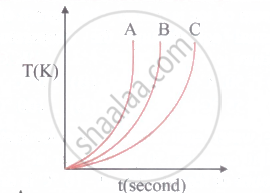
Which of the following substances (A, B and C) has the highest specific heat?
A mixture of one mole of monoatomic gas and one mole of a diatomic gas (rigid) are kept at room temperature (27°C). The ratio of specific heat of gases at constant volume respectively is:
