Advertisements
Advertisements
प्रश्न
Prove the Mayer's relation `C_p - C _v = R/J`
Advertisements
उत्तर
Consider one mole of an ideal gas that is enclosed in a cylinder by a light, frictionless, airtight piston.
Let P, V, and T be the pressure volume and temperature of the gas, respectively. If the gas is heated so that its temperature rises by dT, but volume remains constant.
Let dQ1 → be the amount of heat supplied to the gas,
dE → be the increase in internal energy. Since, volume of gas is constant, no work is done in moving the piston.
dQ1 = dE + dW
∴ dQ1 = dE = CVdT ...(i)
(As dW = 0)

If the gas is heated to the same temperature at constant pressure.
Let dV → be the increase in volume.
Therefore work is done and it is given by
dW = PdV
Let dQ2 → be the heat supplied to the gas
∴ dQ2 = dE + dW
∴ CpdT = dE + dW ...(ii)
Putting dE = CvdT and dW = PdV
∴ Equation (ii) becomes
CPdT = CvdT + PdV
(Cp − Cv)dT = PdV ...(iii)
For one mole of gas
PV = RT
∴ pdV = RdT
∴ (Cp − Cv)dT = RdT
Cp − Cv = R ...(iv)
This is known as Mayer's relation.
Generally, heat supplied is measured in calories, and work done is measured in joules. Therefore, equation (iv) is modified as follows:.
`C_p - C _v = R/J`
APPEARS IN
संबंधित प्रश्न
Specific heat capacity of substance A is 3.8 J g-1K-1 whereas the specific heat capacity of substance B is 0.4 J g-1 K-1
(i) Which of the two is a good conductor of heat?
(ii) How is one led to the above conclusion?
(iii) If substances A and B are liquids then which one would be more useful in car radiators?
Why do the farmers fill their fields with water on a cold winter night?
Water property of water makes it an effective coolant?
Find the time taken by a 500 W heater to raise the temperature of 50 kg of material of specific heat capacity 960 J kg-1K-1, from 18°C to 38° C. Assume that all the heat energy supplied by the heater is given to the material.
Explain the term boiling ?
Study the following procedure and answer the questions below:
1. Take 3 spheres of iron, copper and lead of equal mass.
2. Put all the 3 spheres in boiling water in a beaker for some time.
3. Take 3 spheres out of the water. Put them immediately on a thick slab of wax.
4. Note, the depth that each sphere goes into the wax.
i) Which property of substance can be studied with this procedure?
ii) Describe that property in minimum words.
iii) Explain the rule of heat exchange with this property.
The ratio of specific heat capacity to molar heat capacity of a body _____________ .
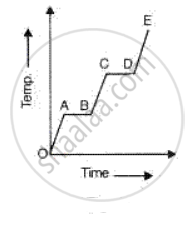
A substance is heated at a constant rate from a low temperature to a high temperature. A graph of temperature against time is shown in the figure. Which part or parts of the graph correspond(s) to the substance existing in two states?
What change in heat energy occurs when lead at its melting point
solidifies without change in the temperature?
If 10125 J of heat energy boils off 4.5 g of water at 100°C to steam at 100°C, find the specific latent heat of steam.
A liquid X has specific heat capacity higher than the liquid Y. Which liquid is useful as coolant in car radiators.
A liquid X has specific heat capacity higher than the liquid Y. Which liquid is useful as heat reservoir to keep juice bottles without freezing?
Does the specific heat capacity of a substance depend upon its mass and rise in temperature only?
Explain, why is water sprayed on roads in evening in hot summer?
Explain, why temperature in hot summer, falls sharply after a sharp shower?
If substances A and B are liquids then which one would be more useful in car radiators?
Given: Specific heat capacity’A’ 3.8 J/g /K. Specific heat capacity ‘B’ 0.4 J/g /K.
An equal quantity of heat is supplied to two substances A and B. The substance A shows a greater rise in temperature. What can you say about the heat capacity of A as compared to that of B?
From the options given below the specific heat of _______ is maximum.
Read the passage and answer the questions based on it.
If heat is exchanged between a hot and cold object, the temperature of the cold object goes on increasing due to gain of energy and the temperature of the hot object goes on decreasing due to loss of energy. The change in temperature continues till the temperatures of both objects attain the same value. In this process, the cold object gains heat energy and the hot object loses heat energy. If the system of both the objects is isolated from the environment by keeping it inside a heat-resistant box then no energy can flow from inside the box or come into the box. In this situation, we get the following principle.
Heat energy lost by the hot object = Heat energy gained by the cold object. This is called the ‘Principle of heat exchange’.
- Where does heat transfer take place?
- In such a situation which principle of heat do you perceive?
- How can this principle be explained in short?
- Measuring the property of which substance this principle is used?
Heat is applied to a rigid diatomic gas at constant pressure. The ratio ΔQ : ΔU : ΔW is ______.
Two metals A and B have specific heat capacities in the ratio 2:3. If they are supplied same amount of heat then
Which metal piece will have greater mass if the rise in temperature is the same for both metals?
Water has the lowest specific heat capacity.
Match the following:
| Column A | Column B | ||
| 1. | Specific heat capacity of water | a. | 0°C |
| 2. | Latent heat of fusion of ice | b. | 2260 J/g |
| 3. | Latent heat of vaporization of water | c. | 100°C |
| 4. | The melting point of iced | d. | 4.2 J/g°C |
| 5. | The boiling point of water | e. | 336 J/g |
Which of the following substances (A, B and C) has the highest specific heat?
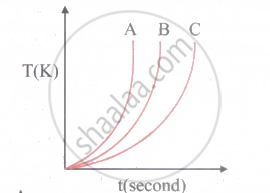
Thermal capacities of substances A and B are same. If mass of A is more than mass of B then:
Which substance will have more specific heat capacity?
In the method of mixtures, a hot metal is dropped into cold water and the mixture reaches a final temperature. Which principle is used to find the specific heat of the metal?
Which method is used to determine the specific heat capacity of both solids and liquids by mixing a substance of unknown specific heat with water?
