Advertisements
Advertisements
प्रश्न
Explain why the specific heat capacity at constant pressure is greater than the specific heat capacity at constant volume.
Advertisements
उत्तर
It implies that to increase the temperature of the gas at constant volume requires less heat than increasing the temperature of the gas at constant pressure. In other words, s is always greater than sv.
APPEARS IN
संबंधित प्रश्न
Give a mathematical relation between Heat Capacity and Specific Heat Capacity.
Why is specific heat capacity taken as a measure of thermal inertia?
Ice-cream at 0°C feels colder than water at 0°C. Give reason for this observation.
An electric immersion heater is rated 1250 W. Calculate the time in which it will heat 20 kg of water at 5°C to 65°C.
Solve the following problem.
Specific latent heat of vaporization of water is 2.26 × 10⁶ J/kg. Calculate the energy needed to change 5.0 g of water into steam at 100 ºC.
When a uniform rod is heated, which of the following quantity of the rod will increase
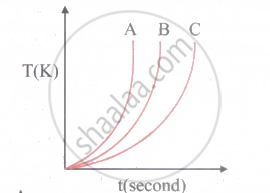
Which of the following substances (A, B and C) has the highest specific heat?
Match the columns:
| Column ‘A’ | Column ‘B’ |
| The SI unit of specific heat capacity | (a) Jkg−1°C−1 |
| (b) kg/m3 | |
| (c) calorie |
