Advertisements
Advertisements
प्रश्न
We would like to make a vessel whose volume does not change with temperature (take a hint from the problem above). We can use brass and iron `(β_(vbrass) = (6 xx 10^(–5))/K and β_(viron) = (3.55 xx 10^(–5))/K)` to create a volume of 100 cc. How do you think you can achieve this.
Advertisements
उत्तर
In the previous problem, the difference in the length was constant.
In this problem the difference in volume is constant.
The situation is shown in the diagram.
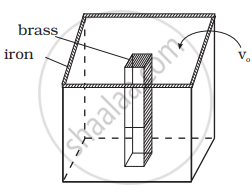
Let Vio, Vbo be the volume of iron and brass vessel at 0°C
Vi, Vb be the volume of iron and brass vessel at Δθ°C,
γi, γb be the coefficient of volume expansion of iron and brass.
As per the question, Vio – Vbo = 100 cc = Vi – Vb ......(i)
Now, `V_i = V_(io) (1 + γ_iΔθ)`
`V_b = V_(bo) (1 + γ_bΔθ)`
`V_i - V_b = (V_(io) - V_(bo)) + Δθ(V_(io)γ_i - V_(bo)γ_b)`
Since, `V_i - V_b` = constant
So, `V_(io)γ_i - V_(bo)γ_b`
⇒ `V_(io)/V_(bo) = γ_b/γ_i`
= `(3/2 β_b)/(3/2 β_i)`
= `β_b/β_i`
= `(6 xx 10^-5)/(3.55 xx 10^-5)`
= `6/3.55`
`V_(io)/V_(bo) = 6/3.55` ......(ii)
Solving equations (i) and (ii), we get
Vio = 244.9 cc
Vbo = 144.9 cc
APPEARS IN
संबंधित प्रश्न
A child running a temperature of 101°F is given an antipyrin (i.e. a medicine that lowers fever) which causes an increase in the rate of evaporation of sweat from his body. If the fever is brought down to 98 °F in 20 min, what is the average rate of extra evaporation caused, by the drug? Assume the evaporation mechanism to be the only way by which heat is lost. The mass of the child is 30 kg. The specific heat of human body is approximately the same as that of water, and latent heat of evaporation of water at that temperature is about 580 cal g–1.
A geyser heats water flowing at the rate of 3.0 litres per minute from 27 °C to 77 °C. If the geyser operates on a gas burner, what is the rate of consumption of the fuel if its heat of combustion is 4.0 × 10⁴ J/g?
Define heat capacity and state its SI unit.
Calculate the mass of ice needed to cool 150 g of water contained in a calorimeter of mass 50 g at 32 °C such that the final temperature is 5 °C. Specific heat capacity of calorimeter = 0.4 J g-1 °C-1, Specific heat capacity of water = 4.2 J g-1°C-1, latent heat capacity of ice = 330 J g-1.
A copper vessel of mass 100 g contains 150 g of water at 50°C. How much ice is needed to cool it to 5°C?
Given: Specific heat capacity of copper = 0.4 Jg-1 °C-1
The Specific heat capacity of water = 4.2 Jg-1 °C-1
The Specific latent heat of fusion ice = 336 Jg-1
A refrigerator converts 100 g of water at 20°C to ice at -10°C in 35 minutes. Calculate the average rate of heat extraction in terms of watts.
Given: Specific heat capacity of ice = 2.1 J g-1°C-1
Specific heat capacity of water = 4.2 J g-1°C-1
Specific latent heat of fusion of ice = 336 J g-1
During the phase change does the average kinetic energy of the molecules of the substance increase?
Write the expression for the heat energy Q received by the substance when m kg of substance of specific heat capacity c Jkg-1 k-1 is heated through Δt° C.
Two metallic blocks P and Q of masses in ratio 2: 1 are given the same amount of heat. If their temperature rise by the same amount, compare their specific heat capacities.
Why do the farmers fill their fields with water on a cold winter night?
Water property of water makes it an effective coolant?
Give one example where high specific heat capacity of water is used as heat reservoir ?
A heater of power P watt raises the temperature of m kg of a liquid by Δt K in time t s. Express
the specific heat capacity of liquid in terms of above data.
Find the time taken by a 500 W heater to raise the temperature of 50 kg of material of specific heat capacity 960 J kg-1K-1, from 18°C to 38° C. Assume that all the heat energy supplied by the heater is given to the material.
Ice cream appears colder to the mouth than water at 0℃. Give reason.
Name two green house gases ?
What is meant by global warming?
What is carbon tax?
Without green house effect, the average temperature of earth’s surface would have been:
(a) – 18℃
(b) 33℃
(c) 0℃
(d) 15℃
Read the following paragraph and answer the questions.
|
If heat is exchanged between a hot and cold object, the temperature of the cold object goes on increasing due to gain of energy and the temperature of the hot object goes on decreasing due to loss of energy. The change in temperature continues till the temperatures of both the objects attain the same value. In this process, the cold object gains heat energy and the hot object loses heat energy. If the system of both the objects is isolated from the environment by keeping it inside a heat resistant box (meaning that the energy exchange takes place between the two objects only), then no energy can flow from inside the box or come into the box. |
- Heat is transferred from where to where?
- Which principle do we learn about from this process?
- How will you state the principle briefly?
- Which property of the substance is measured using this principle?
Equal heat is given to two objects A and B of mass 1 g. Temperature of A increases by 3°C and B by 5°C. Which object has more specific heat? And by what factor?
Study the following procedure and answer the questions below:
1. Take 3 spheres of iron, copper and lead of equal mass.
2. Put all the 3 spheres in boiling water in a beaker for some time.
3. Take 3 spheres out of the water. Put them immediately on a thick slab of wax.
4. Note, the depth that each sphere goes into the wax.
i) Which property of substance can be studied with this procedure?
ii) Describe that property in minimum words.
iii) Explain the rule of heat exchange with this property.
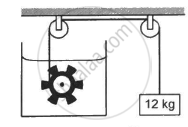
Figure shows a paddle wheel coupled to a mass of 12 kg through fixed frictionless pulleys. The paddle is immersed in a liquid of heat capacity 4200 J K−1 kept in an adiabatic container. Consider a time interval in which the 12 kg block falls slowly through 70 cm. (a) How much heat is given to the liquid? (b) How much work is done on the liquid? (c) Calculate the rise in the temperature of the liquid neglecting the heat capacity of the container and the paddle.
The product of mass and specific heat is known as ..........
Define heat capacity.
If substances A and B are liquids then which one would be more useful in car radiators?
Given: Specific heat capacity’A’ 3.8 J/g /K. Specific heat capacity ‘B’ 0.4 J/g /K.
A substance is in the form of a solid at 0°C. The amount of heat added to this substance and the temperature of the substance are plotted on the following graph:
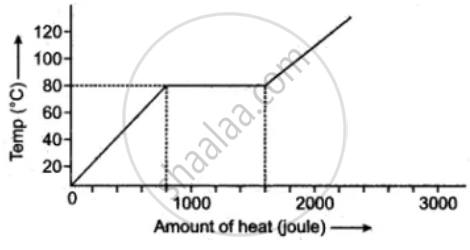
If the specific heat capacity of the solid substance is 500 J/kg °G, find from the graph, the mass of the substance.
How much heat energy is released when 5 g of water at 20° C changes to ice at 0° C?
[Specific heat capacity of water = 4.2 J g-1 ° C-1 Specific latent heat of fusion of ice = 336 J g-1]
Answer the following question.
Why do we generally consider two specific heats of a gas?
All metals have the same specific heat capacity.
Write a short note.
Specific heat capacity
Heat is applied to a rigid diatomic gas at constant pressure. The ratio ΔQ : ΔU : ΔW is ______.
The diagram below shows a cooling curve for 200 g of water. The heat is extracted at the rate of 100 Js-1. Answer the questions that follow:
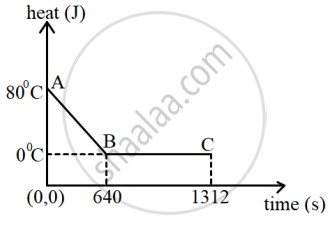
- Calculate specific heat capacity of water.
- Heat released in the region BC.
Specific heat capacity C = ______.
Conductors have generally high specific heat capacities and insulators have low specific heat capacities.
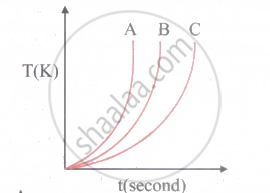
Which of the following substances (A, B and C) has the highest specific heat?
Specific heat capacity of a substance X is 1900 Jkg-1°C-1 means ______.
Give one example where high specific heat capacity of water is used as heat reservoir.
A mixture of one mole of monoatomic gas and one mole of a diatomic gas (rigid) are kept at room temperature (27°C). The ratio of specific heat of gases at constant volume respectively is:
