Advertisements
Advertisements
प्रश्न
Calculate the mass of ice needed to cool 150 g of water contained in a calorimeter of mass 50 g at 32 °C such that the final temperature is 5 °C. Specific heat capacity of calorimeter = 0.4 J g-1 °C-1, Specific heat capacity of water = 4.2 J g-1°C-1, latent heat capacity of ice = 330 J g-1.
Advertisements
उत्तर
Heat lost by hot water = Heat gained by ice + Heat lost by calorimeter + Heat gained by melted ice
`("MC"Δ_t)_"water" + ("MC"Δ_t)_"calorimeter" = "MLL"_"F" + ("MC"Δ_t)_"Melted ice"`
∴ 150 × 4.2 (32 - 5) + 50 × 0.4 × (32 - 5) = M × 330 + M × 4.2 × (5 - 0)
∴ (150 × 4.2 × 27) + (50 × 0.4 × 27) = 330 M + 21 M
17010 + 540 = 351 M
∴ M = `17550/351`
∴ M = 50
Mass of ice required = 50g.
APPEARS IN
संबंधित प्रश्न
Heat energy is supplied at a constant rate to 100g of ice at 0 °C. The ice is converted into water at 0° C in 2 minutes. How much time will be required to raise the temperature of water from 0 °C to 20 °C? [Given: sp. heat capacity of water = 4.2 J g-1 °C-1, sp. latent heat of ice = 336 J g-1].
Explain the term boiling ?
Name the radiations for which the green house gases are opaque ?
Water falls from a height of 50 m. Calculate the rise in the temperature of water when it strikes the bottom.
(g = 10 ms-2; Specific heat capacity of water = 4200 J / kg°C)
_______ is defined as the amount of heat required to raise the temperature of 1kg of a substance by 1°C.
Consider the statement given below and choose the correct option.
Assertion: Radiation is a form of heat transfer which takes place only in vacuum.
Reason: The thermal energy is transferred from one part of a substance to another part without the actual movement of the atoms or molecules.
Define specific heat capacity.
At same temperature and pressure of an ideal gas, ____________.
The diagram below shows a cooling curve for 200 g of water. The heat is extracted at the rate of 100 Js-1. Answer the questions that follow:
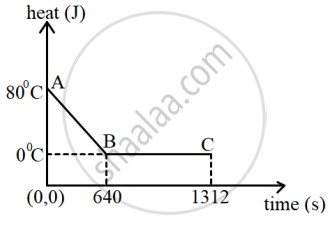
- Calculate specific heat capacity of water.
- Heat released in the region BC.
